
Bodyweight Training as the Defining Fitness Trend of 2026
The fitness industry is shifting away from equipment-heavy approaches toward bodyweight training as the primary foundation — and wall bars have returned as the most versatile tool for developing strength, stability, and long-term physical capability.
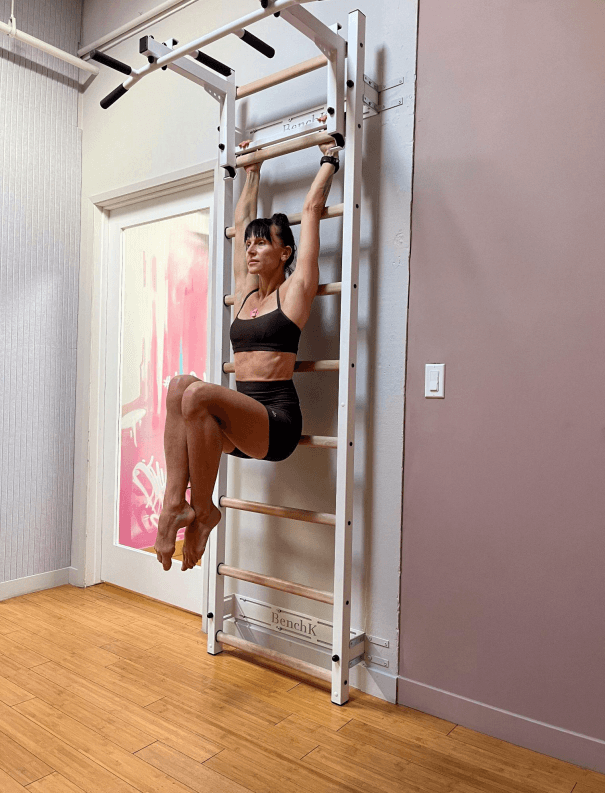
For years, the fitness market was driven by increasingly advanced equipment, more intense programs, and dramatic transformations. But in 2026, we're seeing a clear shift in priorities. Instead of piling on more weight, users have started asking a different question — “is my training actually supporting my health and long-term physical capability?” The answer has led to a return to fundamentals.
Bodyweight training is no longer just an alternative to the gym — it's become a deliberate complement to it, and often the foundation of the entire training plan. This approach doesn't require complex infrastructure or hours spent at a fitness club. What it does require is control, stabilization, and an understanding of your own movement. In a world overloaded with stimuli and technology, simplicity has turned out to be the most advanced solution. Bodyweight training supported by a wall bar system fits perfectly into the modern lifestyle model — efficient, functional, and built for the long haul.
A New Definition of Fitness — The Body as a System, Not a Collection of Muscles
The most important shift of recent years isn't about training methods — it's about mindset. Modern fitness has stopped focusing on muscles in isolation and started viewing the body as one integrated movement system. Training with external loads often creates situations where the body only moves along a predetermined track. The machine stabilizes, and muscles fire in fragments. But real life never works that way — we're always engaging multiple structures at once. Picking up a bag, getting up from the floor, or keeping your balance on the stairs — these are all multi-planar movements that require the coordination of muscles, joints, and the nervous system.
That's exactly why calisthenics has become so relevant. Bodyweight exercises teach the body to manage tension and stabilization. Every movement demands control of the center of gravity, not just force production. The result isn't just a better-looking physique — it's above all a higher quality of physical function. There's a mental component too. Training becomes a form of mindfulness, because without focus, you can't maintain balance or tension control. Unlike repetitive machine sets, here the body is in constant communication with the brain. It's this relationship — the feel of movement — that makes calisthenic training beneficial for both neurological and motor health.
The BenchK Wall Bars — A Versatile Tool for Modern Training
In 2026, wall bars have returned to the mainstream as a solution that perfectly bridges the fundamentals of movement with the expectations of today's user. They're no longer associated with a basic piece of apparatus, but with a multifunctional training system that allows you to develop strength, stabilization, mobility, and body control in one cohesive environment. It's precisely this versatility that has made wall bars one of the most practical elements of modern training — whether the goal is peak fitness, a healthy back, or long-term physical capability.
With BenchK, the added value is that the structure was conceived as a base for working in multiple directions. The wall bars don't lock training into a single template — they open it up to progression, from foundational movement patterns to more demanding calisthenic variations. Importantly, the system can be expanded with additional components over time, making it increasingly versatile — adapted to growing skills, new goals, and the varying needs of different users.
Wall Bars as a Fitness Club Standard — Redefining the Functional Zone
In 2026, a modern fitness club looks less and less like a space filled with rows of treadmills and single-muscle machines. Instead, functional zones are gaining prominence — areas where you train movement, not isolated body parts. This is exactly the environment where the BenchK wall bar system has become one of the most sought-after pieces of equipment — not as an add-on, but as an essential foundation for bodyweight training, mobility work, and stabilization.
For clubs, it's a practical choice — the wall bars support a wide variety of training formats in a single location, without complex infrastructure. On the same structure, you can build pulling and support strength, develop core control through hangs, and run mobility, stretching, or corrective exercise sessions. Crucially, it's a tool that's equally useful for beginners and advanced users — progression comes from body positioning, angle, and leverage, not from adding heavier and heavier loads.
In a fitness club setting, the ability to work with diverse groups is also key — from functional strengthening classes, to athletic preparation, to programs supporting back health and spinal pain prevention. Wall bars are an excellent fit for these needs, enabling safe work on shoulders, hips, and the spine, while regular hangs and support activations naturally promote better posture. The result is equipment that doesn't just “look professional” — it genuinely elevates the quality of the club's offering.
In 2026, it's becoming increasingly clear that the best results come not from multiplying methods, but from intentionally refining the fundamentals. Bodyweight training is back in the spotlight because it develops what we need most — stability, control, and functional capability that pay dividends for years. Wall bars play a significant role here, offering broad development potential at every level. And when combined with a modular design and the option to expand — as with BenchK — training becomes easier to sustain, more adaptable, and naturally “grows” alongside your goals. This isn't a passing trend — it's a direction in which fitness stops being about survival mode and becomes a tool for maintaining everyday capability and improving quality of life.
See the system in full.
Configure your BenchK — wall bar, attachments, and accessories — and ship anywhere in the U.S.