
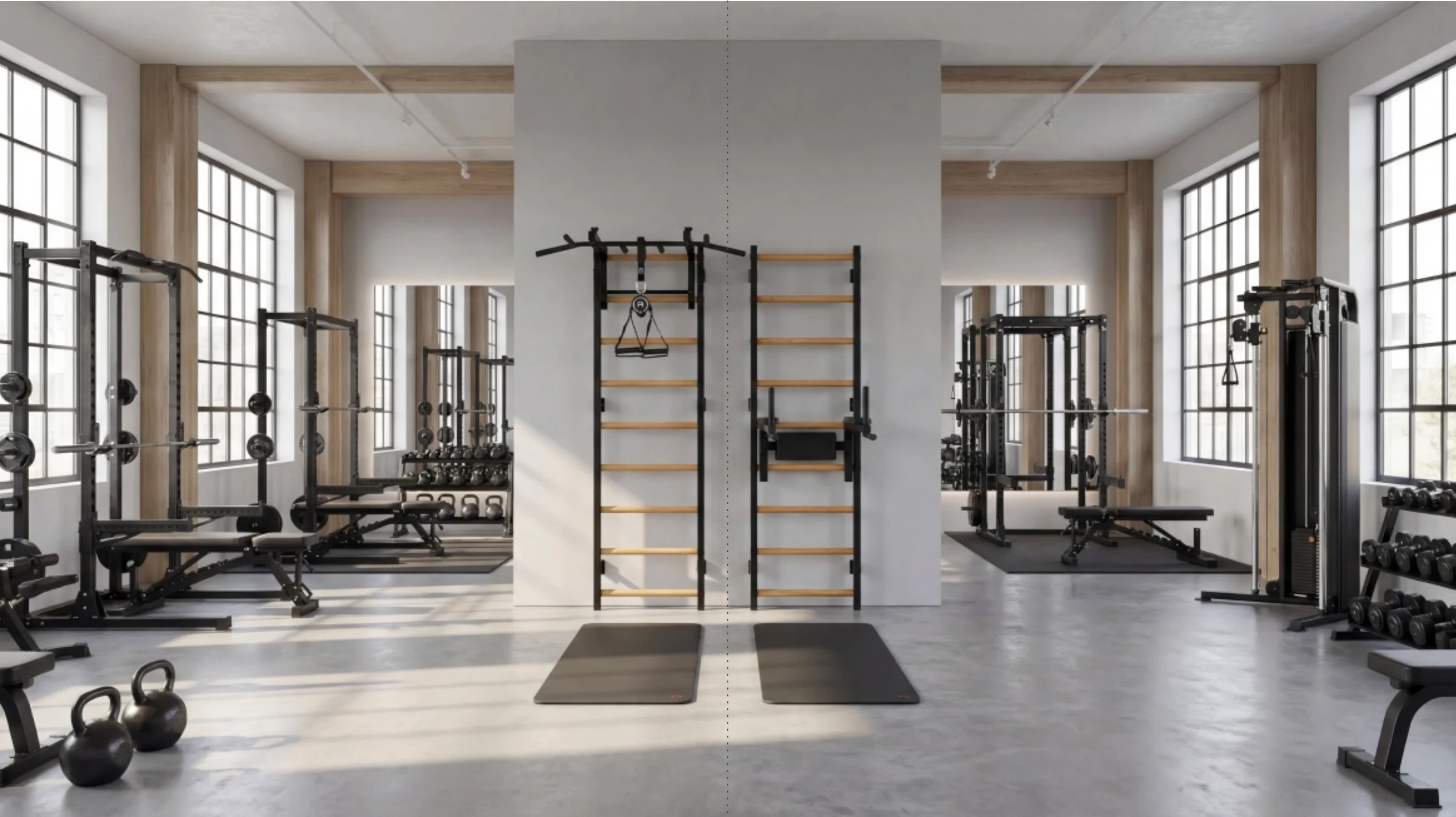
The Swedish ladder, reimagined.
A wall of solid beech rungs for strength, mobility, stretching, and rehab — two centuries old, EU-certified, and built as design-grade equipment for the modern home, studio, and clinic.
Solid beech & steel, EU-certified, rated for 330 lb — ships within 24 hours.
What a Swedish ladder actually is.
At its simplest it’s a wall with rungs on it — but that simplicity is the point. There are no moving parts, no settings, and nothing to calibrate. You hang from it, climb it, brace against it, and anchor a strap, band, or your own body weight to any rung. Once it’s on the wall, it works for the next fifty years.
The same piece of equipment carries three names depending on who’s talking. Stall bars is the term you’ll hear in physical therapy and gymnastics; wall bars is the everyday name; Swedish ladderpoints back to its origin in the Swedish system of gymnastics. They’re all the same thing.
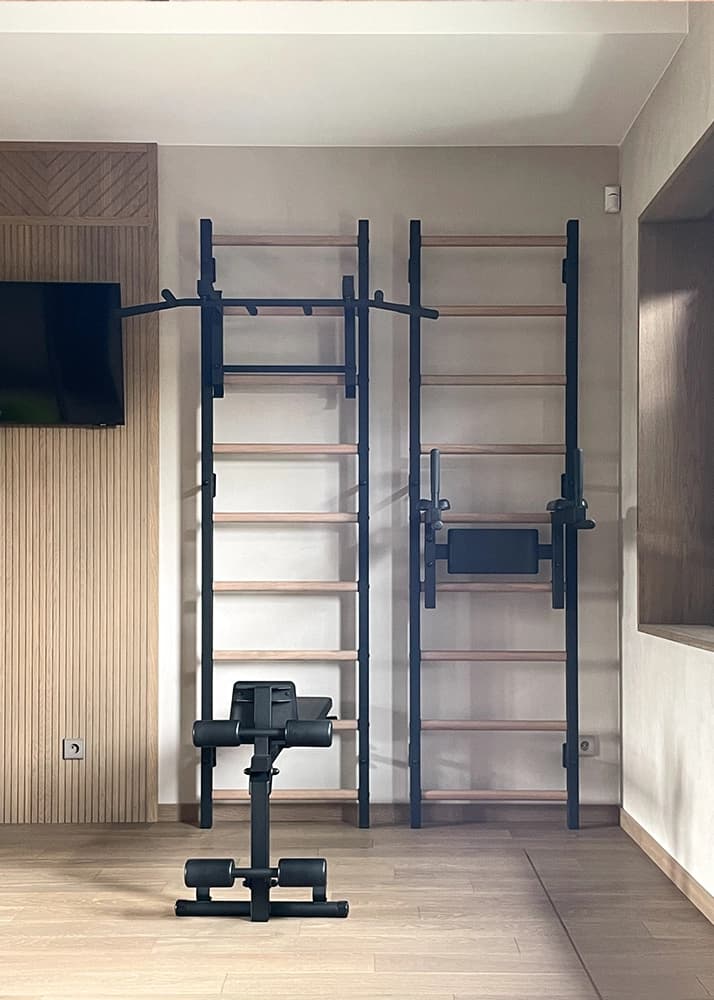
What changes everything is what you bolt onto it. A BenchK ladder accepts a convertible pull-up bar (it flips down to a barbell rest), a dip station, a reversible workout bench, and suspension straps — so a single wall becomes a complete training station you can reconfigure by hand in seconds.
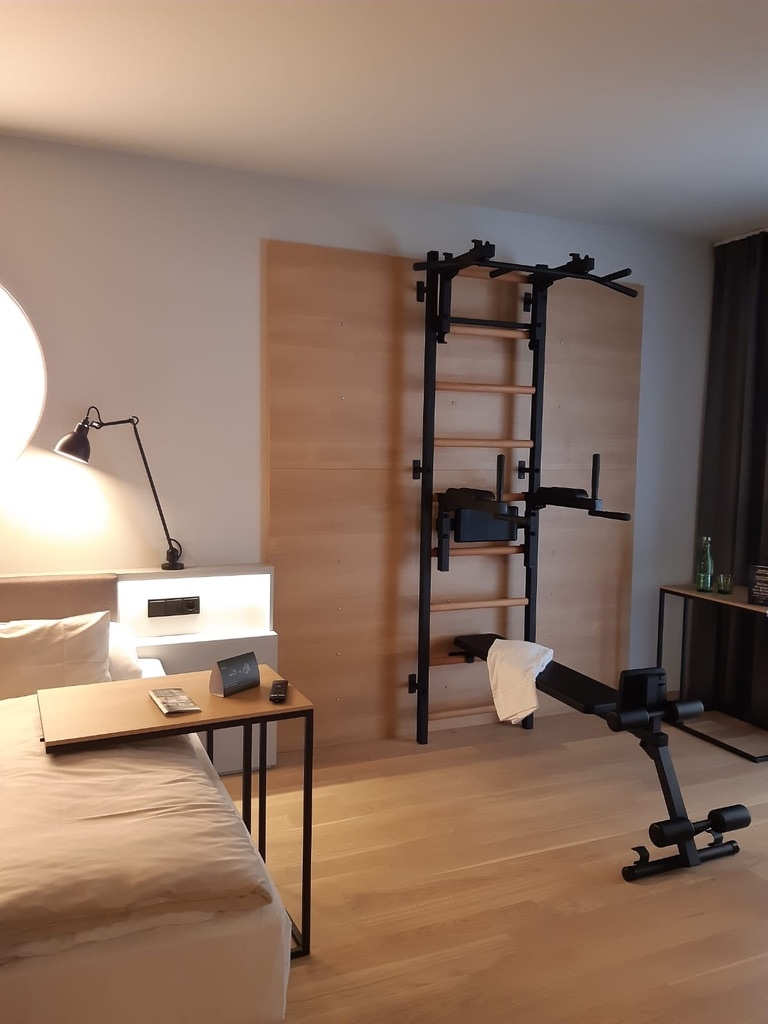
Built for adult, full-body training.
Despite its school-gymnasium roots, a BenchK Swedish ladder is engineered for adult loads — rated for a 330 lb (150 kg)user on solid beech rungs and a steel frame. It’s the backbone of a serious home gym in a footprint the width of a doorway.
For calisthenics, it’s an entire apparatus: strict and weighted pull-ups, dips, hanging leg raises, inverted rows, skin-the-cats, and front-lever progressions, all from one wall. For everyday training, the rungs give you infinite anchor points for bands, straps, and bodyweight variations.
And it grows with you. Start with the ladder, add the convertible pull-up bar and dip station when you’re ready, and you’ve replaced a rack, a pull-up tower, and a dip stand with one quiet wall.
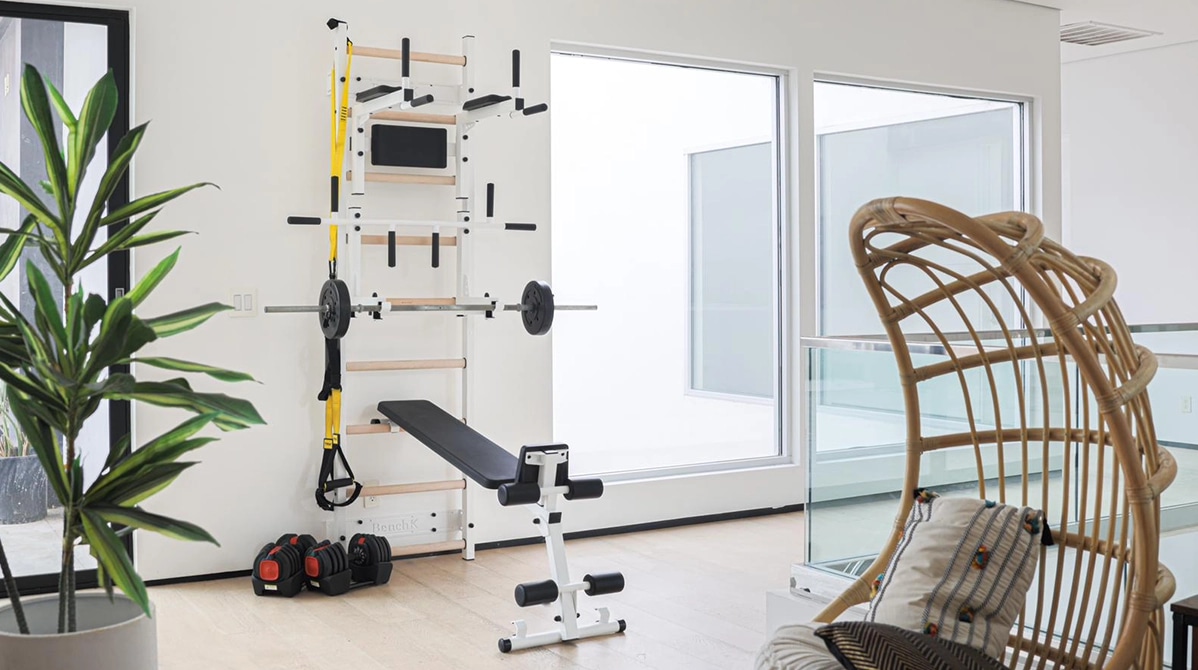
From the living room to the clinic.
The Swedish ladder keeps getting rediscovered from completely different directions. Pilates and barre studios use the bars for spring-loaded resistance, balance, and supported mobility. Physical therapists use them for spinal traction, assisted range-of-motion, and progressive rehab.
Mobility and movement coaches lean on the rungs for hanging decompression and joint-by-joint work; families use the lower rungs for kids while the frame stays rated for the adults in the house. One wall, one piece of equipment, used hard by people who’d never share a gym.
Built for the home, trusted by the institution — the same ladder that hangs in a Stockholm schoolroom design lives just as comfortably in a New York Pilates studio or a Florida PT clinic.
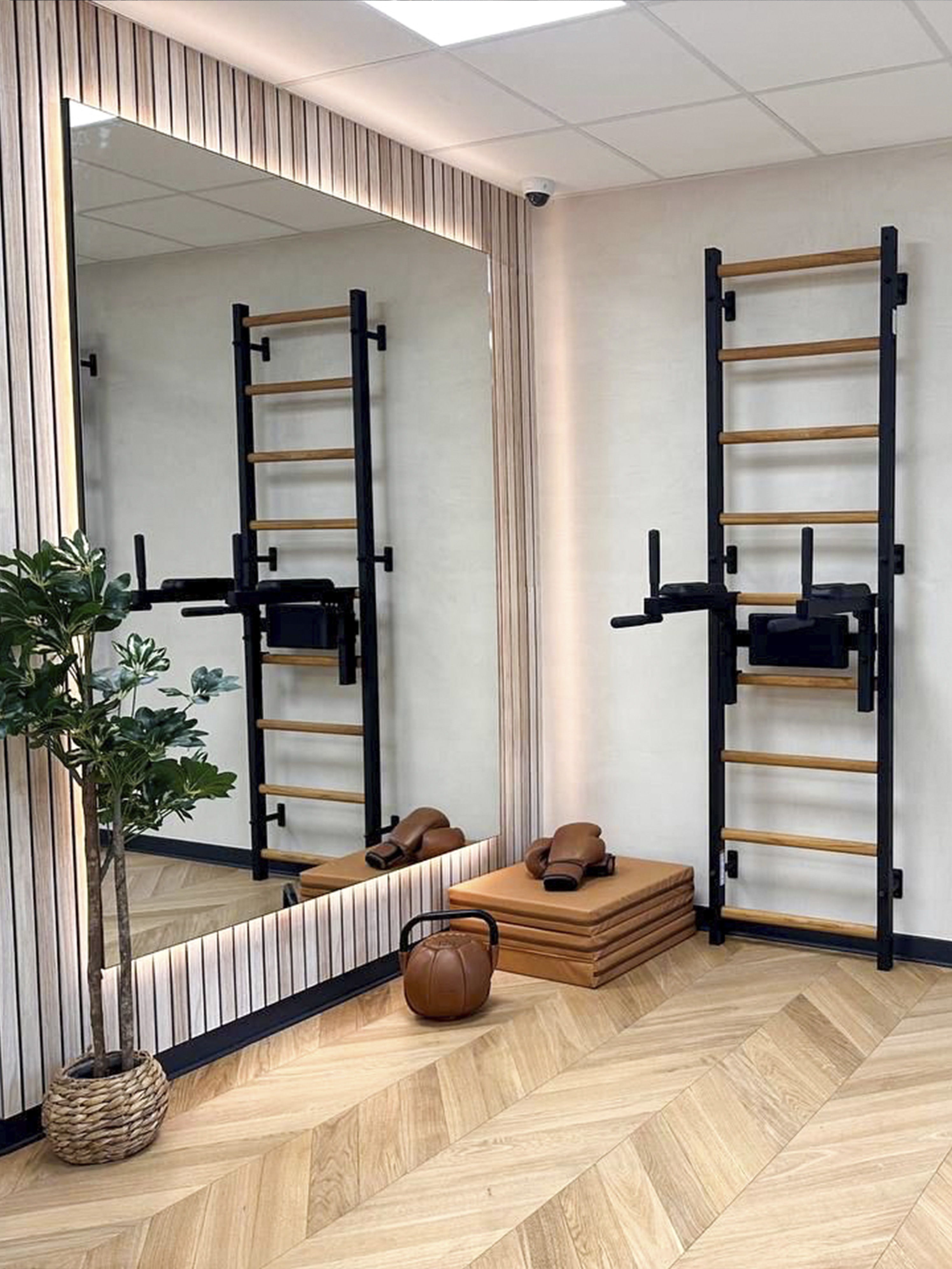
Looking for a Swedish ladder of your own?
Why ours is built differently.
Most of what gets sold as a “wall bar” is a budget rack — light pine, no real attachments, and no load rating you’d trust with a weighted pull-up. A BenchK Swedish ladder is the opposite end of the category: solid beech rungs in a steel frame, finished to live in a room you’re proud of, and certified to the European safety standards PN-EN 12346 and PN-EN 913.
It’s designed and made in Poland, ships within 24 hours, and every attachment is removable by one adult — no permanent commitment to a configuration. That’s the difference between a piece of fitness equipment and a piece of furniture that happens to be the most useful thing on your wall.
How to choose a Swedish ladder.
Three things decide which one is right: your ceiling height, who’s using it, and how far you want the attachment ecosystem to go. BenchK comes in three series — and the head-clearance above the top rung is what usually makes the call.
| Height | Best for | Attachments | Max user | |
|---|---|---|---|---|
| Series 1 | ≈ 7'2" (220 cm) | Entry · kids & teens | Core set | 265 lb |
| Series 2 | ≈ 7'6" (230 cm) | Studios · tighter ceilings | Expandable | 330 lb |
| Series 7 | ≈ 7'10" (240 cm) | Adults · full training | Full ecosystem | 330 lb |
Series 7 is the flagship (~80% of US installs). Check each product page for exact ladder height and minimum ceiling clearance.
What to look for in any Swedish ladder: a real load rating(not a vague “heavy duty”), solid wood rungs over particle board, a steel frame for adult use, proper mounting hardware, and safety certification. All four BenchK series clear that bar — the question is just fit and footprint.
Does IKEA make a Swedish ladder?
It’s a common search — and the honest answer is no. IKEA doesn’t make a purpose-built Swedish ladder; the flat-pack shelving and decorative racks that turn up aren’t engineered or load-rated for training. A real Swedish ladder is a different category of object — built to take an adult’s full body weight, day after day, for decades.
| Load rating | Material | Attachments | Certification | Warranty | |
|---|---|---|---|---|---|
| Flat-pack / décor rack | Light · unrated | Pine or particle board | None | — | Limited |
| BenchK Swedish ladder | 330 lb (150 kg) | Solid beech + steel | Pull-up, dip, bench & more | EU PN-EN 12346/913 | 10 yr on steel |

The Swedish ladder, fully loaded: the BenchK 733.
The flagship Series 7 wall bar pairs a convertible steel pull-up bar (it flips to a 441 lb barbell rest), a dip station, and a reversible bench onto a single wall — every attachment removable by one adult. Made in Poland to EU safety standards, built to outlast the room it’s in.
Best sellers


Swedish ladder FAQ
What is a Swedish ladder?
Is a Swedish ladder the same as stall bars or wall bars?
Are Swedish ladders good for adults?
What can you do on a Swedish ladder?
What size Swedish ladder do I need, and what ceiling height?
How is a Swedish ladder mounted, and how much weight does it hold?
Does IKEA sell Swedish ladders?
Bring the Swedish ladder home.
A BenchK ladder is the direct descendant of Ling's 1813 design — reengineered for contemporary spaces, certified to modern safety standards, and built to outlive everything else in the room.