
Bodyweight Exercise Progression: From Beginner to Advanced (No Weights Needed)
A structured progression takes you from wall push-ups to one-arm push-ups, dead hangs to muscle-ups, basic squats to pistols — using nothing but your body. The secret that separates people who progress from people who plateau: enough variation in hand and foot positions, which is where wall bars become a real advantage.
Why do bodyweight progressions work better than adding weight?
Progressive overload doesn't require a barbell. A 2015 Journal of Strength and Conditioning Research study (Calatayud et al.) showed bodyweight exercises performed at equivalent relative intensity produced similar muscle activation to weighted exercises. Bodyweight progressions change the leverage angle instead of stacking plates.
Leverage-based progression is infinitely scalable. A push-up on your knees loads about 49% of bodyweight through the arms. A standard push-up hits about 64% (Suprak et al., JSCR, 2011). Feet elevated on a 24″ surface: around 74%. One-arm push-up: nearly your full bodyweight through a single arm. No weight plates required.
The problem most people hit is the gap between stages. Going from a standard push-up straight to a one-arm push-up is like jumping from a 135 lb bench press to 300. You need intermediate steps. Many of those steps require elevated surfaces at specific heights — which is exactly what wall bar rungs provide.
What equipment do you actually need?
Technically a floor and something to hang from. Practically the most effective progressions require multiple grip heights, stable elevated surfaces at various levels, and something to hang from at different positions.
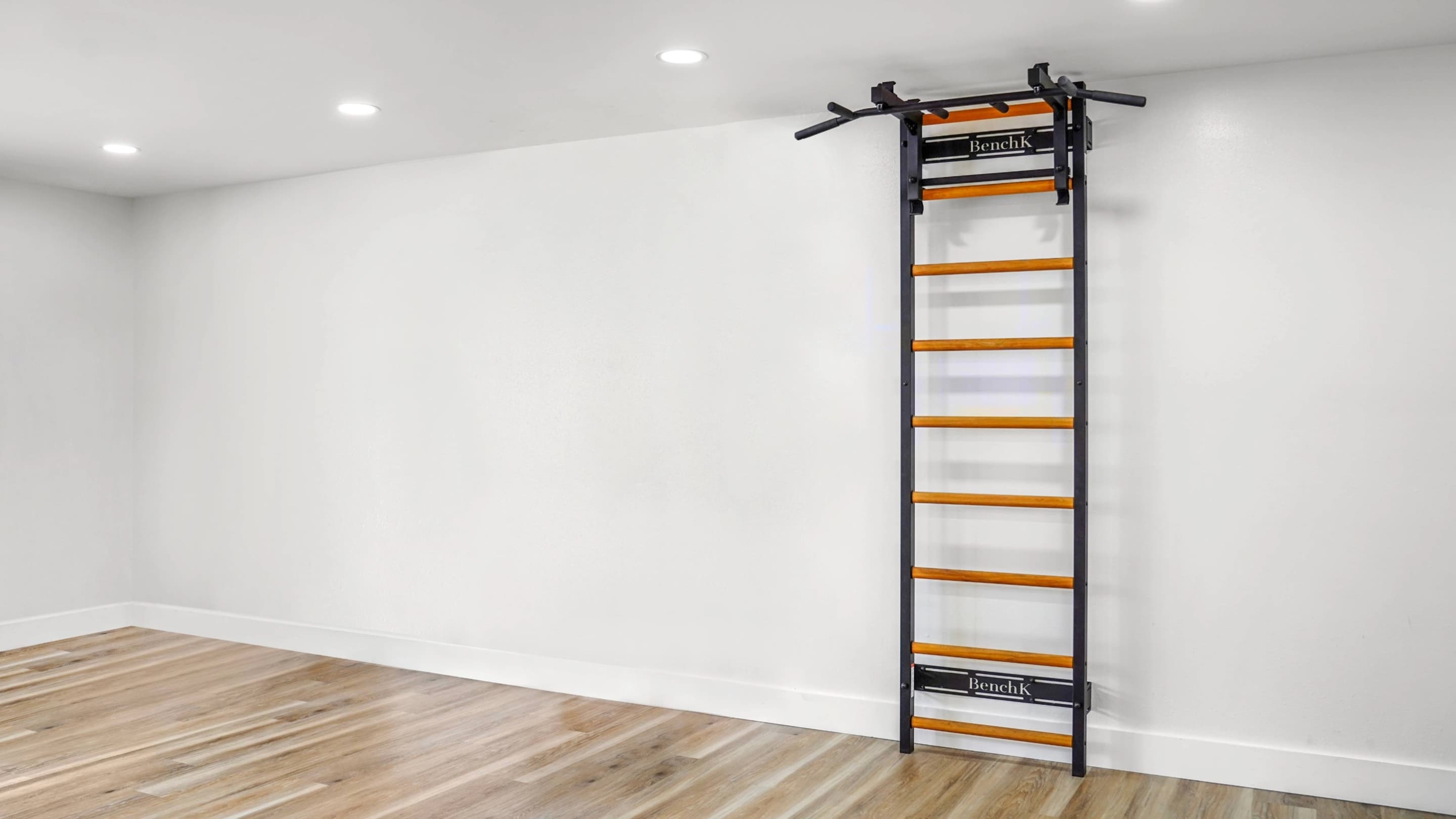
A pull-up bar gives you one height. The floor gives you one height. Wall bars give you 8–9 rungs at graduated heights from floor to overhead, plus a pull-up bar at the top — 10+ training heights from a single piece of equipment that takes zero floor space.
How do you progress push-up variations?
The full push-up progression — six levels:
Level 1 — Wall push-up.Stand arm's length from a wall, hands at shoulder height. About 30–35% of bodyweight through the arms.
Level 2 — Incline push-up (45°).Hands on a surface at hip height, roughly 36″. About 40–50% of bodyweight. Choose the exact height that's the right difficulty.
Level 3 — Standard push-up. Hands on floor, body straight, full range. About 64% (Suprak et al.). Most people stall here because the next jump is too big.
Level 4 — Decline push-up. Feet on a surface 12–24″ high, hands on floor. Shifts to roughly 70–75% of bodyweight to the upper body. Wall bar rungs let you raise feet incrementally.
Level 5 — Feet-elevated diamond push-up. Narrow grip significantly increases tricep and inner-chest activation (Cogley et al., JSCR, 2005).
Level 6 — Archer to one-arm push-up. Archer push-ups transition toward single-arm work. A low rung for the assist hand lets you calibrate exactly how much help that arm gives.
How do you build up to a pull-up from zero?
Level 1 — Dead hang (10–30 sec).If you can't hang for 10 seconds, you're not ready for pulling work. Just hang. Research (Kim & Kim, 2016) found regular dead hangs significantly improved grip strength over 4 weeks.
Level 2 — Active hang (scapular pull-up). From dead hang, retract and depress shoulder blades without bending elbows. 3 sets of 8–10.
Level 3 — Australian row. Grip a bar or rung at waist height, body at an angle, pull chest to the bar. Adjust difficulty by changing height — higher is easier, lower is harder. Drop one rung each week.
Level 4 — Negative pull-up. Step up to chin-over-bar, lower yourself slowly. Target 5 sec on the way down. Eccentric training builds strength 20–40% faster than concentric (Roig et al., 2009).
Level 5 — Band-assisted or foot-assisted pull-up. Loop a band, or place one foot on a rung at knee height. Place foot on progressively lower rungs as you get stronger.
Level 6 — Full pull-up. Once you hit 3 sets of 8, add difficulty: wide grip, L-sit pull-ups, weighted.
Dip progression
Dips are the most underrated upper-body exercise — chest, shoulders, triceps at the same time.
Level 1 — Bench dip (feet on floor). About 50% of bodyweight.
Level 2 — Bench dip (feet elevated). Feet up on a rung or step.
Level 3 — Negative dip on parallel bars. Start at the top, lower for 5 sec. Step back up using a rung.
Level 4 — Full parallel bar dip. Elbows to 90° minimum. When you hit 3 sets of 10, ready for weighted dips or ring dips.
Core progression
Level 1 — Dead bug. Face up, arms and legs extended to ceiling. Lower opposite arm and leg. PTs start nearly every patient here.
Level 2 — Hanging knee raise. Hang from bar, knees to chest. Activates lower abs significantly more than any floor crunch (Escamilla et al., 2006).
Level 3 — Hanging leg raise (straight legs). Wall bars behind you prevent swinging.
Level 4 — Toes to bar. Genuine advanced movement; months of work.
Level 5 — Windshield wipers. Legs to bar, rotate side to side.
Level 6 — Front lever progression. Tuck, one-leg-out, straddle, full. Hook feet at different heights to find the exact assistance level.
Pistol squat progression
Level 1 — Bodyweight squat.Below parallel, heels down. If you can't get there, work ankle mobility first.
Level 2 — Split squat. Rest the back foot on a low rung for stability.
Level 3 — Bulgarian split squat. Rear foot elevated on a rung 12–18″ high. Pick the exact elevation that challenges without overwhelming.
Level 4 — Assisted pistol squat. Hold a rung at waist height for balance. Progressively lighten your grip.
Level 5 — Full pistol squat. 3 sets of 5 per leg = legitimately impressive lower-body strength.
A complete weekly program
| Focus | Key exercises (at your current level) | |
|---|---|---|
| Monday | Upper push | Push-up progression (3x8–12), Dip progression (3x6–10), Pike push-up (3x8) |
| Tuesday | Lower body | Squat progression (3x8–12), Split squat (3x8), Calf raises (3x15) |
| Wednesday | Upper pull | Pull-up progression (3x5–8), Australian row (3x8–12), Bicep curl on suspension trainer (3x10) |
| Thursday | Core | Hanging progression (3x8–12), Dead bug (3x10), Pallof press on suspension trainer (3x10) |
| Friday | Full body | Circuit: push, pull, squat, core — 4–5 rounds |
| Weekend | Recovery | Stretching, hanging, mobility work |
The Recoil S2 suspension trainer ($399 base) adds a serious dimension. Rows, chest presses, pikes, hamstring curls fill gaps that pure calisthenics misses. Push-button adjustment changes angles in about 2 seconds — meaningful for circuit work with 30-second rest.
Why wall bars specifically
A BenchK 721B ($1,069) gives you 9 graduated rungs plus a steel 6-grip pull-up bar:
- Graduated difficulty adjustment — micro-adjust difficulty one rung at a time
- Multiple pull-up grip positions — wide, narrow, neutral, mixed
- Zero floor space — full system mounts to the wall, under 11 sq ft of wall space
- Anchor points for advanced work — handstands against the bars, feet hooked for front-lever practice, hands on rungs for L-sit progression
The full calisthenics setup: wall bars + dip bar (DB1B, $629) + Recoil S2 ($399) = $2,097. Every bodyweight progression covered, 10-year metal warranty.
Realistic timelines
| Typical timeline | |
|---|---|
| First full push-up (from wall push-up) | 4–8 weeks |
| First full pull-up (from dead hang) | 3–6 months |
| First full dip | 2–4 months |
| Pistol squat | 4–8 months |
| Muscle-up | 12–24 months |
| Front lever (full) | 18–36 months |
| One-arm push-up | 6–12 months |
| One-arm pull-up | 24–48 months |
Assumes consistent training and honest progression — not skipping levels.
The most common mistake in calisthenics is jumping ahead because intermediate levels feel boring. That's how shoulders and wrists get wrecked.
Frequently asked questions
Can bodyweight exercises build as much muscle as weight training?
What's the difference between calisthenics and bodyweight training?
Do I need a pull-up bar for bodyweight progressions?
How often should I test my max level in each progression?
Are wall bars better than a power tower for calisthenics?
Can I train bodyweight exercises every day?
What if I'm stuck at the same progression level for weeks?
Is suspension training part of bodyweight training?
See the system in full.
Configure your BenchK — wall bar, attachments, and accessories — and ship anywhere in the U.S.