
Chiropractic Office Exercise Equipment: What to Recommend Patients
The best chiropractic office exercise equipment does three things: it serves multiple patients per hour without reconfiguration, takes minimal floor space, and supports the exercises chiropractors actually prescribe — spinal traction, core stabilization, postural correction. Wall-mounted systems check all three boxes while enabling billable exercise therapy under CPT codes 97110 and 97530.
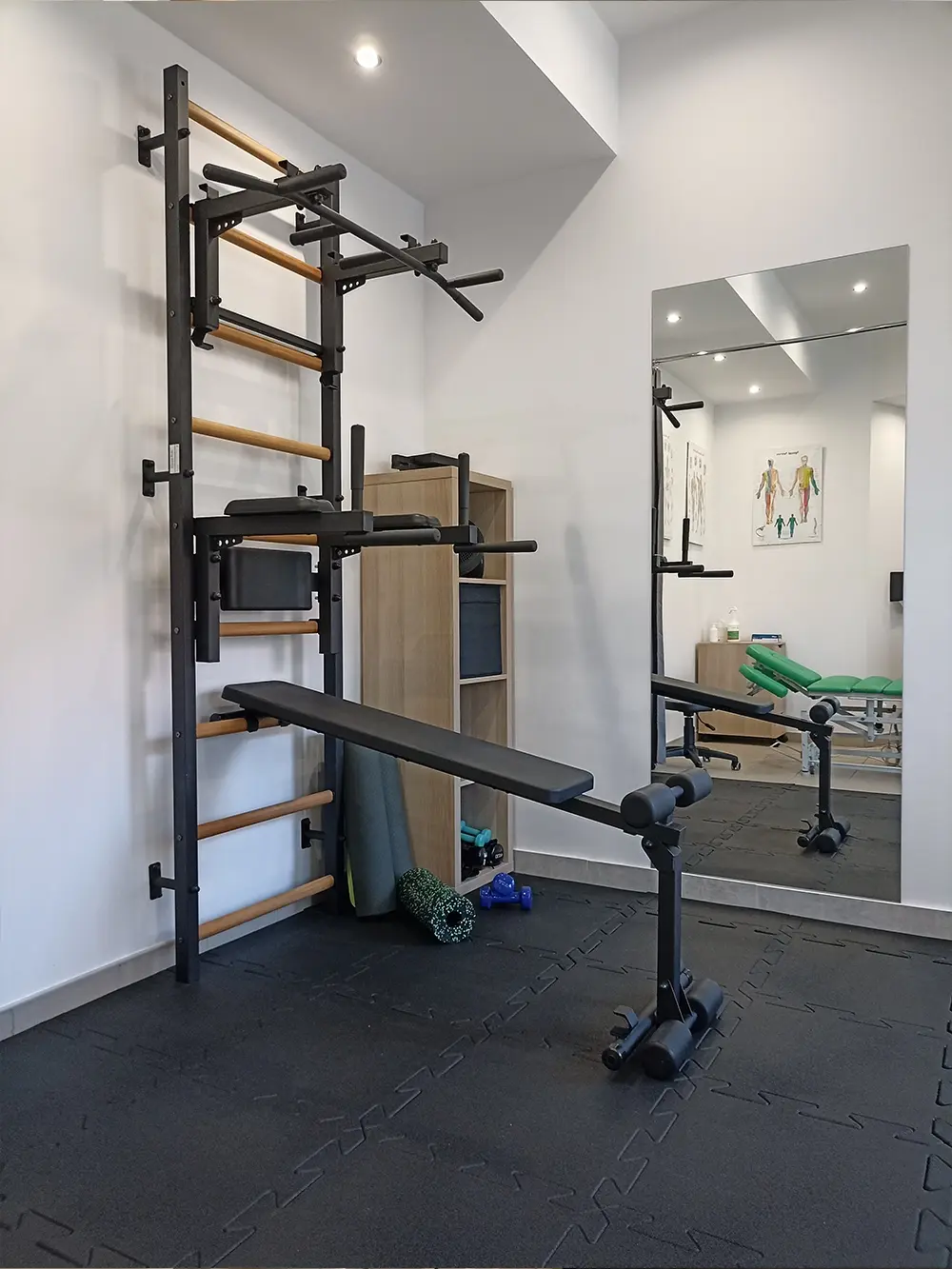
Why chiropractors need in-office exercise equipment
The profession is shifting. Manual adjustment alone is increasingly seen as incomplete care. The ACA's guidelines emphasize active care — patient-performed exercise — alongside passive treatment. A 2017 J. Manipulative and Physiological Therapeutics systematic review (Coulter et al.) found spinal manipulation combined with exercise produced better outcomes for chronic low back pain than manipulation alone.
In-office exercise equipment lets you:
- Prescribe and supervise exercises — patients who do exercises in your office are far more likely to maintain the routine at home
- Bill for exercise therapy under CPT 97110 and 97530 (per 15-min unit)
- Improve outcomes — active care between adjustments maintains gains
- Differentiate your practice — most chiropractic offices have a treatment table, a TENS unit, maybe a foam roller. Exercise equipment signals comprehensive care.
What exercises do chiropractors prescribe most on wall bars?
Spinal traction and decompression
Graduated hanging. Patient grips a rung at an appropriate height — not necessarily the top rung. Feet stay on the floor or on a lower rung. Body weight creates gentle axial traction. Same principle as a mechanical traction table — but the patient controls the load.
Practical advantage over a mechanical traction table: wall bars need no setup time, and multiple patients can use adjacent units simultaneously. A traction table serves one patient at a time, occupies 20+ sq ft permanently, costs $3,000–$8,000, and needs 10–15 minutes of setup per session.
Segmental decompression. Patient drapes their body over a rung at the targeted spinal level — chest height for thoracic kyphosis, waist height for lumbar extension. Different rungs target different segments.
Core stabilization
Dead bug variations with feet on rungs. Patient lies face up, feet hooked on a low rung, arms reaching overhead to grip a higher rung. Anchored position isolates anti-extension core work — foundation of any lumbar stability program.
Pallof press with suspension trainer. A Recoil S2 Gym ($429) on the wall bars gives patients anti-rotation core exercises. Push-button adjustment changes resistance in 2 seconds.
Hanging knee raises. For stronger patients. Kim et al. (J. Physical Therapy Science, 2016) found hanging exercises superior to floor-based core work for activating the transversus abdominis.
Postural correction
Wall angel equivalent. Patient stands with back to bars, shoulder blades touching a rung. Slides arms up and down with the rung providing proprioceptive feedback on scapular position. The rung is narrower than a flat wall, forcing the patient to actively find correct positioning.
Thoracic extension over a rung. Patient drapes backward over a rung at thoracic level, arms overhead. Counteracts the forward-head, rounded-shoulder posture that brings most patients through the door.
Chin tuck with overhead reach. Patient grips a rung overhead, performs a chin tuck while maintaining the overhead position. Grip creates cervical traction while the chin tuck activates deep neck flexors.
CPT billing codes
| Description | Typical rate per 15-min unit | Wall bar applicability | |
|---|---|---|---|
| 97110 | Therapeutic Exercise | $28–$38 | Hanging, core work, postural exercises |
| 97530 | Therapeutic Activities | $30–$42 | Functional movement patterns on wall bars |
| 97150 | Group Therapeutic Procedures | $18–$25 per patient | 2–3 patients on adjacent units, one provider |
Exercise must be prescribed for a specific diagnosis, supervised by a licensed provider, and documented.
Revenue model per wall bar unit
| Conservative | Moderate | Optimistic | |
|---|---|---|---|
| Patients using unit per day | 3 | 5 | 8 |
| 15-min units per patient | 1 | 1.5 | 2 |
| Daily revenue per wall bar (avg $32) | $96 | $240 | $512 |
| Annual revenue | $24,000 | $60,000 | $128,000 |
| Equipment cost (721B + Recoil S2 Gym) | $1,498 | $1,498 | $1,498 |
| Payback period | ~16 days | ~7 days | ~3 days |
What configuration works best?
Starter (2 stations). 2x BenchK 721B ($1,069 each) + 2x Recoil S2 Gym ($429 each) = $2,996.
Full treatment wall (6 stations). 6x BenchK 721B + 6x Recoil S2 Gym = $8,988.
Why the 721B. Series 7 has 9 rungs (more height options), 150 kg capacity, easy-to-wipe powder-coated steel, and the PB2 pull-up bar with 6 grip positions. Width is 67 cm — tight enough to install multiple units along one wall.
Why the Recoil S2 Gym. Permanent Recoil Mount with hex wrench system — clinical environments need fixed, reliable anchoring, not door anchors. Push-button adjustment changes resistance in 2 seconds between patients.
Floor space — often the deciding factor
67 cm wide on the wall, zero floor space when not in use. About 6 feet of clearance during exercise.
| Permanent floor space | Patients per hour | |
|---|---|---|
| Cable machine | 20–30 sq ft | 1 |
| Traction table | 20–25 sq ft | 1 |
| Reformer | 40–50 sq ft | 1 |
| Wall bars (per unit) | 0 sq ft | 2–3 |
| Total gym | 15–20 sq ft | 1 |
In a 1,200 sq ft chiropractic office, two wall bar units on a single wall can serve 6–10 patients daily — matching the throughput of 3–4 pieces of floor-standing equipment at a fraction of the footprint.
Patient safety + compliance advantage
- Fixed mounting — bolted to wall studs, no tipping risk
- Progressive loading — patients control traction intensity, no sudden forces
- Multiple grip heights — patients grip where comfortable
- Safety certifications — PN-EN 12346:2001 and PN-EN 913:2019
- 150 kg (330 lb) capacity — handles virtually all patients
Compliance advantage: supervised in-office exercise adherence runs 75–80%, vs. 30–40% for home programs (Palazzo et al., BMC Musculoskeletal Disorders, 2019). When the equipment is in your treatment room, "do your exercises" becomes "let me show you right now."
You can also recommend the same wall bars for patients' homes. BenchK wall bars start at $635 (200B base model).
How wall bars compare to other chiropractic equipment
| Wall bars + Recoil | Cable machine | Total Gym | Traction table | |
|---|---|---|---|---|
| Cost per station | $1,498 | $3,000–8,000 | $2,000–4,000 | $3,000–8,000 |
| Floor space | 0 sq ft | 20–30 sq ft | 15–20 sq ft | 20–25 sq ft |
| Patients/hour | 2–3 | 1 | 1 | 1 |
| Maintenance | None | Cable/pulley | Glide rail | Cable/motor |
| Traction | Yes (body weight) | No | Limited | Yes (mechanical) |
| Core exercises | 15+ variations | 8–12 | 5–8 | 0 |
| Same equipment at home | Yes | No | Different models | No |
| Warranty | 10 years (metal) | 1–3 years | 5 years | 1–3 years |
Frequently asked questions
Can chiropractors bill insurance for exercise therapy on wall bars?
How many wall bar units does a chiropractic office need?
Are wall bars safe for elderly or deconditioned patients?
What exercises work best for post-adjustment maintenance?
Do wall bars need special installation?
Can patients buy the same wall bars for home?
How do wall bars compare to a traction table?
What's the realistic ROI timeline?
Specifying for a clinic, studio, or hotel?
Talk to a commercial specialist. Bulk pricing, mounting guidance, and net-30 terms on three-unit and larger orders.