
Corporate Wellness Room Equipment: What Actually Gets Used
The most effective corporate wellness room equipment requires no scheduling, no instruction, and no change of clothes. Equipment that requires dedicated workout time and athletic clothing typically sees usage rates under 20% of eligible employees. Equipment that allows 2-minute stretch breaks in office clothes consistently sees significantly higher engagement.
Why most corporate wellness rooms fail
Corporate wellness programs assume employees will block 30–60 minutes for exercise during work hours. A 2021 SHRM survey found while 76% of employees value wellness benefits, only 24% regularly use employer-provided fitness facilities. The gap isn't motivation — it's friction.
The friction points that kill usage:
- Change of clothes.Gym clothes + showering + changing back makes the real time commitment 45–60 min. Most employees won't do that during work.
- Scheduling conflicts. 50–200 employees sharing 2–3 pieces of equipment makes scheduling a barrier nobody bothers with.
- Instruction needed. Cable machines, rowing machines, even some bikes require explanation. Without an on-staff trainer, complex equipment sits unused.
- Social anxiety. Many employees feel self-conscious exercising in front of colleagues. A treadmill behind glass walls is a performance stage.
- All or nothing.Traditional gym equipment implies a "real workout." The employee who just wants to stretch their back for 2 minutes doesn't feel like the wellness room is for them.
Solution: equipment that reduces all five friction points to zero.
What equipment actually gets used
Category 1 — Standing & stretching stations (highest usage)
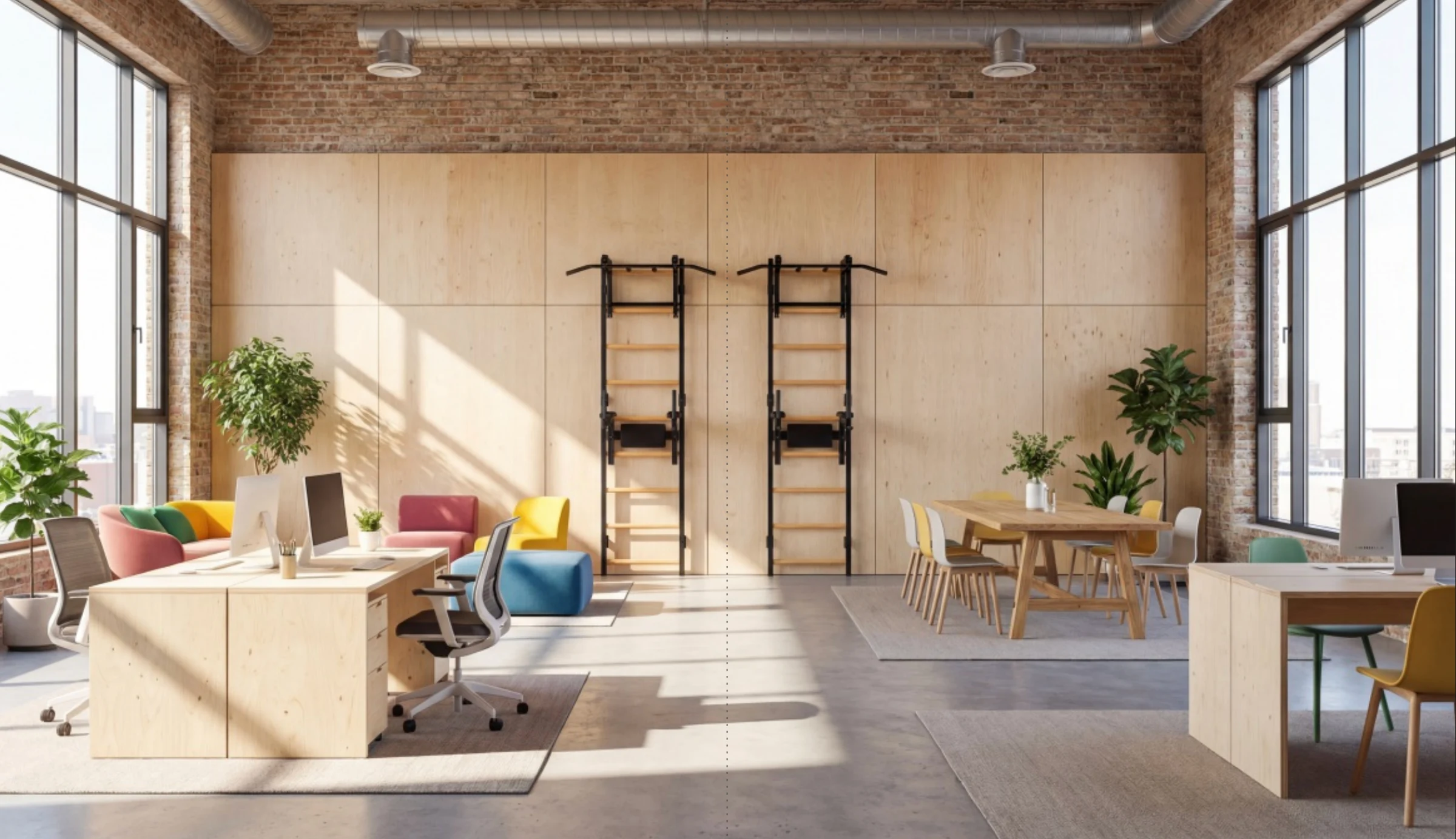
Wall-mounted bars with desk attachment. A BenchK 712B ($1,109) combines wall bars with a beech pull-up bar and a BenchTop desk attachment. In an office, this means:
- As a standing desk. The BenchTop holds a laptop at standing height. An employee walks over, stands, works for 20–30 min. No clothing change.
- As a stretch station. When not serving as a desk, the bars provide 9 rungs for shoulders, hips, hamstrings, spine. A 2-minute break in office clothes.
- As a pull-up bar. The beech bar sits at the top for a quick set of pull-ups or dead hangs.
The dual-purpose design is what makes this work: the desk attachment normalizes the equipment. It's not "gym equipment waiting for someone brave enough to use it." It's a standing desk that happens to also be a stretch station.
Category 2 — Simple resistance tools (moderate usage)
Suspension trainer (permanently mounted). A Recoil S2 Gym ($429) provides bodyweight exercises. In an office, most employees use it for assisted stretching, light rows, and shoulder mobility. Push-button adjustment matters — employees can change in 2 sec without fumbling.
Resistance bands. Low-cost, low-barrier. Hang them on the rungs.
Category 3 — Recovery equipment (steady usage)
Foam rollers, massage balls, yoga mats. Always available, always used. No instruction, no clothing change.
The "morning stretch club" phenomenon
Someone — usually whoever sits closest to the wall bars — starts a 5-minute morning stretch routine. Back stretch, shoulder stretch, a couple of dead hangs. Five minutes, work clothes.
Within a week, a colleague joins. Within a month, there's a small group doing 5–10 minutes of stretching together each morning. It becomes a social ritual, not an exercise obligation. Nobody calls it "working out." They call it "the morning stretch."
This organic adoption pattern works because:
- Low barrier — 5 minutes, work clothes, no sign-up
- Social proof — seeing a colleague stretch makes it normal
- Visible location — bars in a common area are a constant invitation
- Habit stacking — attaches to arriving at work, an existing habit
Budget comparison
| Cost | Floor space | |
|---|---|---|
| Treadmill | $2,000–5,000 | 20–30 sq ft |
| Stationary bike | $1,000–3,000 | 12–15 sq ft |
| Dumbbell set | $300–800 | 10–15 sq ft |
| Yoga mats (5) | $100–200 | Stored |
| Total | $3,400–9,000 | 42–60 sq ft permanent |
| Cost | Floor space | |
|---|---|---|
| 2x BenchK 712B (bars + pull-up + desk) | $2,218 | 0 sq ft |
| Foam rollers + mats | $200 | Stored |
| Resistance bands | $50 | Hung on bars |
| Total | $2,468 | 0 sq ft permanent |
Option B costs 30–70% less and takes zero permanent floor space. The BenchK 712B includes the BenchTop desk attachment — the single most-requested workplace wellness amenity according to SHRM surveys. Add 2x Recoil S2 Gym ($429 each) for suspension training = $3,326 total.
How to get employees to use the space
Placement
- Put it where people already go — near the kitchen, coffee machine, or main walkway. Not in a basement.
- Make it visible — wall bars on a visible wall are a constant invitation. Equipment hidden in a room nobody passes is a budget line item.
- Keep the floor clear — open, uncluttered space feels approachable.
Culture
- Leadership uses it first — when the office manager does a morning stretch, everyone has permission.
- Don't mandate it — forced wellness is an oxymoron.
- Celebrate the ritual, not the exercise — "the morning stretch club" sounds like community. "The employee exercise program" sounds like compliance.
Budget-friendly entry point
For offices under 20 employees or tighter budgets:
- 1x BenchK 200B ($635) — base wall bars with 8 rungs
- Foam roller + yoga mat ($50)
- Total: $685
- Add desk attachment later: BT076M ($149). Updated total: $834.
Covers the core use case: a stretch station employees can use in 2 minutes without changing clothes.
Frequently asked questions
What corporate wellness equipment sees the highest usage?
How much space does a corporate wellness area need?
Is wellness room equipment tax-deductible?
How do you measure wellness room ROI?
What's the difference between wall bars and a pull-up bar for office use?
Can wall bars be installed in a rented office?
Do coworking spaces use wall bars?
What exercises can employees do in work clothes?
Specifying for a clinic, studio, or hotel?
Talk to a commercial specialist. Bulk pricing, mounting guidance, and net-30 terms on three-unit and larger orders.