
Grip Strength Training: Why It Matters and How to Build It
Grip strength is one of the strongest predictors of overall health and longevity — stronger than blood pressure. A 2015 Lancet study (Leong et al., n=139,691) found every 5 kg decrease in grip correlated with 17% higher cardiovascular mortality. Wall bars are grip training tools by nature — every exercise on them requires you to grip a rung.
Why grip strength predicts your health
The Lancet finding wasn't a one-off. Celis-Morales et al. (BMJ, 2018, n=502,293 from UK Biobank) found lower grip strength was associated with higher rates of cardiovascular disease, respiratory disease, COPD, and death from all causes — even after adjusting for age, sex, body size, smoking, and physical activity. McGrath et al. (J. Alzheimer's Disease, 2019) linked low grip to faster cognitive decline.
Why does a hand squeeze predict so much? Grip is probably a proxy for total musculoskeletal health. If your grip is weak, your whole body is likely weaker than it should be. Grip connects through the forearms, upper arms, shoulders, and core. Strong grip usually means a functionally strong body.
How grip strength changes with age
| Men (kg) | Women (kg) | |
|---|---|---|
| 20–29 | 46–54 | 29–34 |
| 30–39 | 45–53 | 28–33 |
| 40–49 | 43–51 | 27–32 |
| 50–59 | 39–47 | 25–30 |
| 60–69 | 34–42 | 22–27 |
| 70–79 | 29–37 | 19–24 |
Grip peaks in your late 20s to early 30s, then declines — faster after 50. The good news: grip responds well to training at any age. A 2019 systematic review (Labott et al., J. Aging Phys. Activity) confirmed resistance training significantly improved grip strength in adults over 60. You can reverse years of decline with consistent work.
Test your grip strength at home
Dead-hang test
| What it means | |
|---|---|
| Under 15 sec | Below average — make grip training a priority |
| 15–30 sec | Average for someone who doesn't train grip |
| 30–60 sec | Good functional baseline |
| 60–120 sec | Strong grip |
| Over 2 min | Very strong — competitive territory |
Farmer's carry test
Pick up a heavy object in each hand. If you can't carry 50% of your body weight (split between both hands) for 30 seconds without your grip failing, you have room to improve.
The three types of grip
Crush grip— closing your hand around something. Handshakes, gripping handles, squeezing tools. What most people picture when they think "grip strength."
Support grip— holding onto something for time. Hanging from a bar, carrying grocery bags, farmer's walks. Endurance-based and most relevant for daily life.
Pinch grip — gripping between thumb and fingers. Picking up a plate by its rim, holding a thick book in one hand. Often the weakest component and the first to fade with age.
Wall bars hit all three.
12 grip exercises on wall bars
Support grip
1. Dead hang. Hang from the top rung or pull-up bar. 3 sets of 15–30 sec to start, build to 3×60 sec.
2. Single-arm hang. One hand. Much harder. Start with 3×5–10 sec per hand. Will immediately show you which hand is weaker.
3. Towel hang. Drape a towel over a rung. Grip the towel ends. The thick soft material forces fingers to squeeze far harder. 3×10–20 sec.
4. Farmer's hang. Grip rungs at hip or waist height, arms at your sides, feet on the ground, body rigid. 3×30–60 sec.
Crush grip
5. Rung squeeze hangs. While hanging, actively crush the rung as hard as you can for 5 sec. Relax. Repeat 10 times. 3 sets.
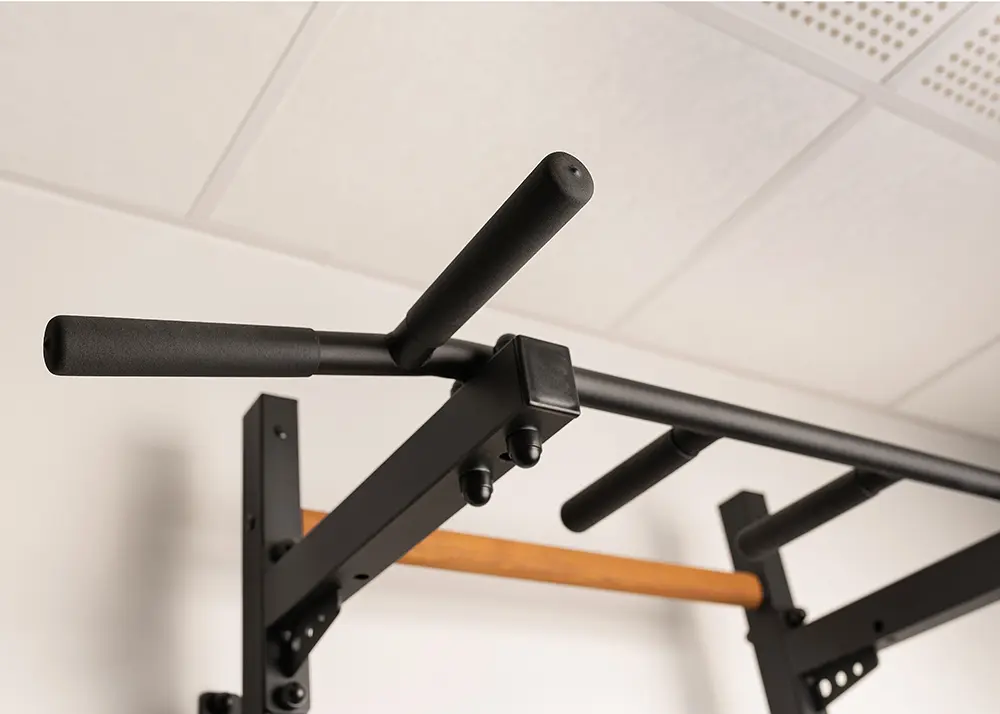
6. Thick-grip pull-up bar work. The PB2 6-grip bar has wider positions that force the hand to work harder. 3 sets of 15–30 sec hanging or 3–5 pull-ups.
Pinch grip
7. Rung-edge pinch. Pinch the top edge — thumb on one side, fingers on the other. Feet stay on the ground at first. 3×10–15 sec.
8. Book pinch hold. Not a wall bar exercise but a perfect complement: stack 2–3 books, pinch-grip them, hold 30 sec per hand.
Dynamic grip
9. Rung-to-rung traverse. Move sideways across the bars — right hand grabs a rung, left reaches next. Across and back = 1 rep. 3 reps.
10. Vertical climbing. Climb bottom to top, then descend. Every rung is a dynamic grab. 5–8 climbs per session. Literally what wall bars were designed for.
11. Rung pull-ups. Pull-ups gripping the rungs instead of a pull-up bar. Round diameter, horizontal orientation. 3×3–8.
Suspension grip
12. Recoil S2 grip work.Suspension handles move under load, demanding constant grip adjustment that static bars don't require. Non-slip textured rubber grips work barefoot/barehanded.
12-week progressive grip program
| Targets | Frequency | |
|---|---|---|
| Weeks 1–4 (Foundation) | Dead hang 3×20→30 sec · Farmer's hang 3×20→30 sec · Traverse 2→4 crossings · Climbing 3→5 ascents | 3x/week, 10–15 min |
| Weeks 5–8 (Development) | Dead hang 3×30→45 sec · Single-arm 3×5→15 sec · Towel hang 3×10→20 sec · Rung pull-ups 3×3→5 | 3–4x/week, 15–20 min |
| Weeks 9–12 (Strength) | Dead hang 3×45→60 sec · Single-arm 3×15→25 sec · Towel hang 3×20→30 sec · Pinch 3×10→15 sec · Traverse 6 crossings | 4x/week, 15–20 min |
After Week 12, retest. Most people see 30–50% improvement in hang time. Maintain with 2–3 grip sessions per week mixed into regular routine.
What wall bars do you need for grip training?
BenchK 221B ($1,069) — best option for grip-focused training. The steel 6-grip pull-up bar (PB2) gives 6 hand positions: wide, narrow, neutral, angled. Eight beech rungs for hangs, traverses, and climbing. 150 kg capacity.
BenchK 200B ($635) — base wall bars, no pull-up bar. Fine for hangs, traverses, climbing, and rung-based grip work. Add a pull-up bar later.
Add: Recoil S2 ($399)— adds dynamic moving-handle grip challenges that static bars can't replicate.
A note for climbers
Wall bars are a solid supplementary training tool. They won't replace a hangboard for finger-specific crimping work, but they handle:
- General grip endurance (round rung dead hangs)
- Traverse practice for movement efficiency
- Pull-up and lock-off strength from rung pull-ups
- Full-body conditioning
- Recovery stretching
Most climbing coaches recommend both sport-specific hangboard training and general grip strength work. Wall bars cover the general half.
Frequently asked questions
Why does grip strength predict mortality?
How often should I train grip?
Can grip strength improve after age 60?
What counts as strong grip strength?
Do wall bars actually build grip strength?
Is grip training the same as forearm training?
How fast will my grip improve?
Can grip training help with arthritis?
See the system in full.
Configure your BenchK — wall bar, attachments, and accessories — and ship anywhere in the U.S.