
What $1,000 / $2,000 / $3,000 Buys You in Home Gym Equipment
The best home gym at any budget isn't the one with the most equipment — it's the one you'll actually use every day. At $1,000 you build a solid single-purpose setup. At $2,000 you get real versatility. At $3,000 you're building something that can replace a gym membership for good.
Before you spend: three questions that matter
1. What do you actually do? A powerlifter needs a rack and barbell. A yoga practitioner needs open floor and maybe a suspension trainer. A person with back pain needs decompression and mobility equipment. Buying equipment for the workout you think you should do — instead of what you will do — is the single biggest source of wasted gym money.
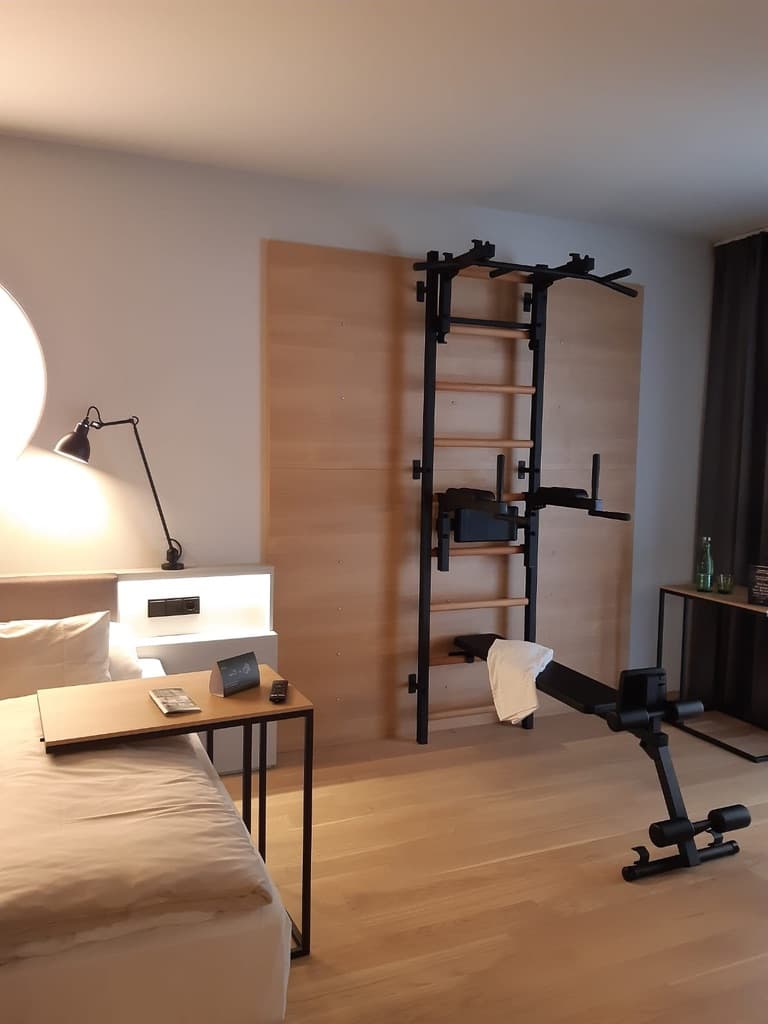
2. How much space do you have? A power rack needs 50–70 sq ft permanently. A wall-mounted system takes 0 sq ft of floor space when not in use. Apartments and garages demand different strategies.
3. Who else will use it? Equipment for one person can be specialized. Equipment shared by a couple or family needs versatility. A setup perfect for one training style collects dust for everyone else.
The $1,000 tier — one good thing
At $1,000 you can't do everything. You can do one thing well.
Option A — Barbell + rack ($900–$1,100)
Squat stand or half rack ($300–$500), Olympic barbell ($250–$350), 255 lb bumper plate set ($300–$450), floor mat ($40–$50). Total: $890–$1,350.
Best for powerlifters and strength athletes. You can squat, bench, deadlift, overhead press, row. Highest-value $1,000 setup if barbell training is your thing.
Trade-off. No pull-ups (unless your rack has a bar), no dips, no suspension training, no stretching assistance. Takes 50–70 sq ft permanently.
Option B — Wall-mounted training system ($915–$1,139)
BenchK 211B ($915) — Series 2 wall bars with adjustable beech pull-up bar. Or 211B + A076 ($1,139) — same plus gymnastic accessories (rope, rings, swing).
Best for bodyweight trainers, back-pain sufferers, families, apartment dwellers.
What you get. Pull-ups, hanging leg raises, graduated spinal decompression at 8 rung heights, full-body stretching, bodyweight rows, incline push-ups at variable angles, climbing. Add A076 and you get ring work and rope climbing too. Over 100 exercises, zero floor footprint.
Trade-off.No barbell, no external resistance loading beyond bodyweight. Wrong choice for someone who needs to squat heavy. Right choice for someone who wants daily movement, decompression, and equipment that doesn't dominate the room — particularly strong for families.
Option C — Smart gym (~$1,000–$1,200)
Entry-level options like the Speediance Gym Monster Lite or a used/refurbished Tonal. Tech-forward users who want guided workouts and cable-style resistance.
Trade-off. Subscription costs ($39–$49/month), potential durability issues at lower price points, resistance limits advanced lifters will outgrow.
Option D — Bands + dumbbells ($370–$740)
Heavy band set, pull-up bar, used adjustable dumbbells, gymnastic rings, yoga mat. Best for minimalists, travelers, renters who can't modify walls. Most versatile in exercise variety, but the resistance ceiling is low.
The $2,000 tier — real versatility
Option A — Full barbell setup ($1,800–$2,200)
Full power rack with pull-up bar ($500–$800), Olympic barbell ($250–$350), 300 lb plates ($400–$600), adjustable bench ($150–$300), mats ($80–$120), dumbbell pair ($150–$300). Covers 90% of what a commercial gym offers for lifting. 60–80 sq ft.
Option B — Wall-mounted station ($2,127)
BenchK 721B ($1,069) + Recoil S2 Home with door mount ($429) + DB1B dip bar ($629). Everything from the $1,000 tier plus: 6 different pull-up grip positions, dips with PU armrests, hanging leg raises, and the Recoil S2 for rows, chest press, pike, and hundreds of other exercises. The Recoil works standalone — take it to a hotel room with the door mount.
Why this beats the rack for some people.If you'll never squat 300 lb but want pull-ups, dips, suspension, core, decompression, and stretching every day — this delivers more usable variety in zero floor space.
Option C — Functional fitness hybrid ($1,800–$2,200)
Squat stand, barbell, plates, adjustable dumbbells, kettlebells, used rower or bike, floor mats. Covers strength, conditioning, and bodyweight. 80–100 sq ft.
The $3,000 tier — gym replacement
Option A — Full garage gym ($2,800–$3,200)
Power rack with lat pulldown ($800–$1,200), barbell + specialty bar ($350–$550), 400 lb plates ($500–$700), quality adjustable bench ($250–$400), adjustable dumbbells ($350–$430), kettlebells ($120–$200), rower or assault bike ($400–$700), mats ($100–$150). A legitimate gym. 100–150 sq ft.
Option B — Maximum wall system ($3,134)
BenchK 733B — Series 7, convertible PB3 pull-up bar/barbell holder, dip bar, bench ($2,735). Recoil S2 standard ($399). Total: $3,134.
Wall bars with 9 rungs, a pull-up bar that doubles as a barbell holder (supports up to 200 kg / 440 lb), dip bar with armrests, a rotatable bench that folds flat against the wall, and a suspension trainer that clips to any rung.
What this does that a garage gym doesn't.It disappears when you're done training. Bench folds flat. Dip bar hangs on the wall. Suspension trainer clips to a rung. Your room is your room again. Try that with a power rack and 400 lb of plates.
Limit.Maximum barbell load is 200 kg — covers most people but won't satisfy competitive powerlifters. Barbell and plates not included; budget $250–$500 extra.
The comparison table
| $1K Barbell | $1K Wall Bars | $2K Rack | $2K Wall Station | $3K Garage | $3K Max Wall | |
|---|---|---|---|---|---|---|
| Floor space | 50–70 sq ft | 0 sq ft | 60–80 sq ft | 0 sq ft | 100–150 sq ft | 0 sq ft |
| Squat | Yes | No | Yes | No | Yes | No |
| Bench press | Limited | No | Yes | No | Yes | OHP via PB3 |
| Pull-ups | Maybe | Yes | Yes | Yes (6-grip) | Yes | Yes (6-grip) |
| Dips | No | No | Maybe | Yes | Maybe | Yes |
| Suspension | No | No | No | Yes | No | Yes |
| Decompression | No | Yes | No | Yes | No | Yes |
| Daily stretching | No | Yes | No | Yes | No | Yes |
| Family friendly | Low | High | Low | High | Low | High |
| Aesthetics | Gym look | Furniture | Gym look | Furniture | Gym look | Furniture |
The honest bottom line
If you lift barbells. Spend your money on a rack, bar, and plates. No wall-mounted system or smart gym replaces heavy barbell training.
If you want daily movement more than heavy lifting. Wall-mounted systems deliver more variety per dollar in less space. A BenchK 211B at $915 serves a family of four — pull-ups for one partner, stretching for the other, climbing for kids.
If you want guidance and tracking.Smart gyms at $2,000+ are genuinely useful if you'll use the subscription. Factor in ongoing costs before comparing to one-time purchases.
If you're in an apartment. Floor space is everything. Wall-mounted systems and resistance bands are your realistic options.
If you have a garage with no space constraints. Go barbell + rack. Add wall bars later for stretching and decompression.
Frequently asked questions
What's the best home gym equipment for $1,000?
Is a wall-mounted gym better than a power rack?
How much space does a home gym need?
What home gym equipment holds its value?
Is Tonal worth it compared to traditional equipment?
Can you build a full home gym for $2,000?
What equipment is best for back pain at home?
Build your wall.
Choose a series, size your space, and add the attachments you need — we'll quote it before you check out.