
Home Gym Equipment You'll Actually Use Every Day (Not Just January)
The exercise equipment most people actually use every day shares three traits: it's visible, it requires zero setup, and it takes less than two minutes to start. Equipment that lives in a closet, needs assembly, or takes up ugly floor space gets abandoned — often within weeks of purchase. The single best predictor of whether home gym equipment gets used is whether you can see it from your daily routine.
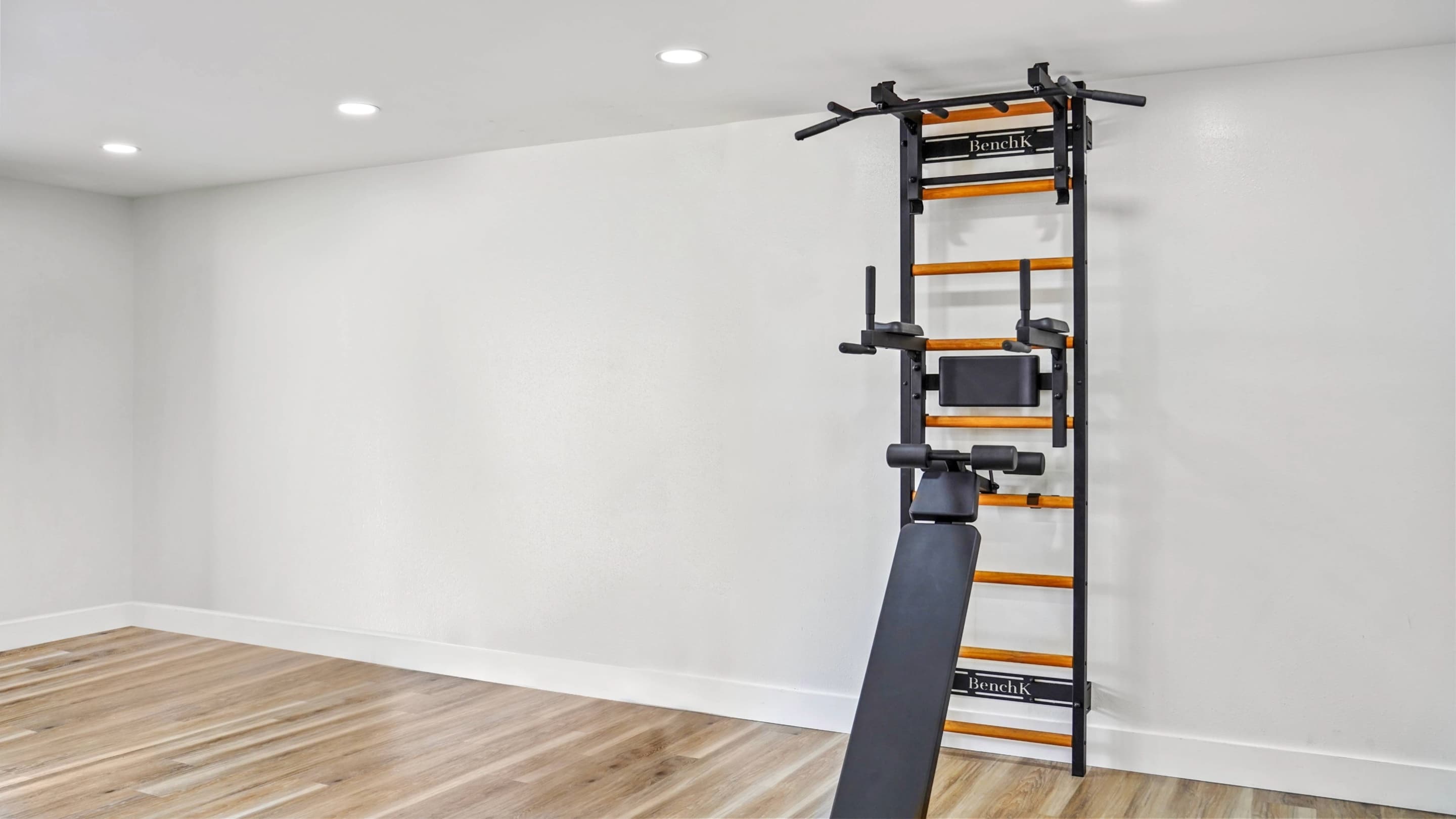
The real reason most home gym equipment collects dust
You probably already know this from experience. The treadmill becomes a clothes rack. Dumbbells migrate under the bed. Resistance bands end up in a drawer you forgot existed. It's not a willpower problem — it's a design problem.
Behavioral psychologists call it "friction." Shawn Achor (The Happiness Advantage, 2010) found that reducing the activation energy for a habit by just 20 seconds dramatically increased follow-through — the "20-Second Rule." Twenty seconds is the margin between "I do this daily" and "I haven't touched it since February."
Applied to home fitness:
- Storage friction — equipment in a closet requires a conscious decision to retrieve. That decision costs willpower.
- Setup friction — equipment that needs assembly, inflation, cable routing adds 2–10 minutes of non-exercise time. Feels like hours when you're tired.
- Aesthetic friction — equipment your partner hates gets moved to a less visible spot. Less visible means less used.
- Commitment friction — equipment that demands a 30-minute session feels like a big ask on a busy Tuesday. If you can't do something meaningful in 5 minutes, you often choose nothing.
Visible = used (this isn't marketing — it's behavioral science)
James Clear wrote about environment design in Atomic Habits (2018): the most reliable way to build a habit isn't motivation — it's making the desired behavior the path of least resistance in your physical environment. Same principle that makes a fruit bowl on the counter more effective than fruit in the fridge.
- If you can see it, you remember it exists. Equipment behind a closed door is functionally invisible.
- If it's always ready, you skip the "workout decision." Grab a rung. Hang 30 seconds. That was a workout. Often becomes 5 minutes.
- If it looks good, it stays visible. Nobody exiles beautiful furniture to the garage.
Five traits of equipment that gets used daily
1. Zero setup time
If it's ready the instant you are, you'll use it between meetings, during a commercial break, while the coffee brews.
2. Permanent visibility
It lives in a room you actually use every day. Living room, home office, bedroom — not a dedicated gym room you have to walk to.
3. Aesthetic approval
The person who makes the purchase decision isn't always the person who makes the home decor decision. If your equipment fails the "partner test," it moves to the spare room. Spare room means forgotten.
4. Micro-workout friendly
Useful for 2-minute sessions, not just 30-minute workouts. A 30-second dead hang between Zoom calls. A quick set of pull-ups before dinner. These accumulate into real fitness over weeks.
5. Multi-user / multi-purpose
If only one family member uses it, it's personal equipment. If the whole household engages, it becomes part of the home — like a dining table.
Why wall bars pass every test (and where they don't)
Zero setup. Walk up, grab a rung, start. A Recoil S2 Home ($429) clips onto a rung in about 3 seconds.
Permanent visibility.They mount on the wall. Most people install in the living room, home office, or bedroom. They can't migrate to the garage because they're physically attached to the wall.
Aesthetic approval.Series 1 ($649–$1,389) uses solid FSC-certified beech wood — it looks like Scandinavian furniture. Series 2 and 7 combine beech rungs with matte black or white powder-coated steel. People who visit your home ask "what is that?" because it doesn't look like gym equipment.
Micro-workout friendly. Morning dead hang: 30 sec. Lunch break stretch: 2 min. Post-meeting pull-ups: 1 min. None require changing clothes.
Multi-user.Kids climb (you'll see this within the first week). Adults do pull-ups, stretching, decompression, strength work. Older family members use lower rungs for balance.
Where wall bars don't win
- Heavy lifting. If you want to bench press 300 lb, you need a bench and barbell. Wall bars complement heavy training but don't replace it.
- Cardio. Wall bars don't replace running, cycling, or rowing.
- Guided workouts. No screen telling you what to do next. Learning curve is about a week.
- Installation commitment. They bolt to the wall. For renters, this is a real consideration.
The equipment graveyard
| Common failure mode | Typical use duration | |
|---|---|---|
| Treadmill | Too large, becomes clothes rack | A few weeks to a couple months |
| Stationary bike | Uncomfortable seat, monotonous | 6–10 weeks |
| Adjustable dumbbells | Needs space, weight-selection friction | Months, then sporadic |
| Resistance bands | Lost in drawers, snap risk | 2–6 weeks |
| Ab roller | Hurts knees, one exercise, boring | 1–3 weeks |
| Doorway pull-up bar | Damages frame, limited exercises | 2–4 months |
| Wall bars | Permanently visible, zero setup | Ongoing — main 'failure' is moving homes |
What a real day with wall bars looks like
Not a dream scenario. An actual Tuesday:
7:00 AM.Walk past on the way to the kitchen. Hang for 30 sec — spinal decompression from sleeping. Stretch hamstrings using a rung at waist height. Total: 2 min. You didn't plan this.
10:30 AM. Between meetings. Three pull-ups, quick shoulder stretch. 90 sec.
12:30 PM. Lunch break. Quick Recoil circuit: rows, chest press, squat jumps. Eight minutes because you felt like it.
6:00 PM. Kids climbing rungs and messing around on gymnastic rings. You do some dips or just hang and decompress while half-watching them play.
9:30 PM. Full-body stretch using different rung heights. Dead hang for 60 sec.
Total active time: 15–25 min split across 5 moments. None required planning. None required motivation. They happened because the equipment was there, ready, visible.
What to start with
Just the basics — $649.BenchK 100 (Series 1). Solid beech, 8 rungs, 120 kg capacity. Purest expression of "visible, ready, beautiful." Add accessories later as you discover what you want.
Most popular — $915. BenchK 211B (Series 2). Steel frame, beech rungs, adjustable beech pull-up bar. 150 kg capacity.
Full daily system — $1,344. 211B ($915) + Recoil S2 Home ($429). Wall bars plus 100+ suspension exercises. S2 Home includes a door mount, so you keep training when you travel.
Frequently asked questions
Why does home gym equipment usually go unused?
What's the best home gym equipment for small spaces?
How do I convince my partner to let me buy home gym equipment?
Are wall bars worth it compared to a gym membership?
Can you get a full workout from wall bars?
How long does installation take?
Do wall bars work for complete beginners?
See the system in full.
Configure your BenchK — wall bar, attachments, and accessories — and ship anywhere in the U.S.