
Hotel Fitness Center Equipment Guide: Maximum Impact, Minimum Space
The best hotel fitness center equipment delivers three things: it works for guests at every fitness level without staff instruction, it looks premium enough to photograph for social media, and it takes minimal floor space in rooms that cost $50–200 per square foot annually.
Why hotel fitness centers are getting a rethink
Guest expectations have shifted. Industry surveys show that a majority of travelers consider fitness amenities when choosing a hotel, but satisfaction with hotel gyms ranks among the lowest amenity scores. The problem isn't the absence of fitness centers — it's that most are uninspiring: a treadmill, an elliptical, dumbbells, fluorescent lighting.
For boutique hotels and lifestyle brands, the fitness center has become a design opportunity. The same guests who choose a hotel for its lobby aesthetic judge the gym by the same standard.
What makes a hotel fitness center "Instagram-worthy"?
Guest-generated social media content is one of the most powerful marketing tools a hotel has. Stackla (now Nosto, 2022) found 79% of consumers say user-generated content highly impacts their purchasing decisions. A hotel gym that photographs well gets shared. Every guest who photographs your gym is an unpaid marketing ambassador.
Wall-mounted training systems photograph well because:
- Natural materials stand out — beech wood and matte steel against a clean wall reads as design, not equipment
- Clean lines — floor stays clear, room looks spacious even when small
- Unusual — most guests have never seen wall bars in a fitness center; novel equals shareable
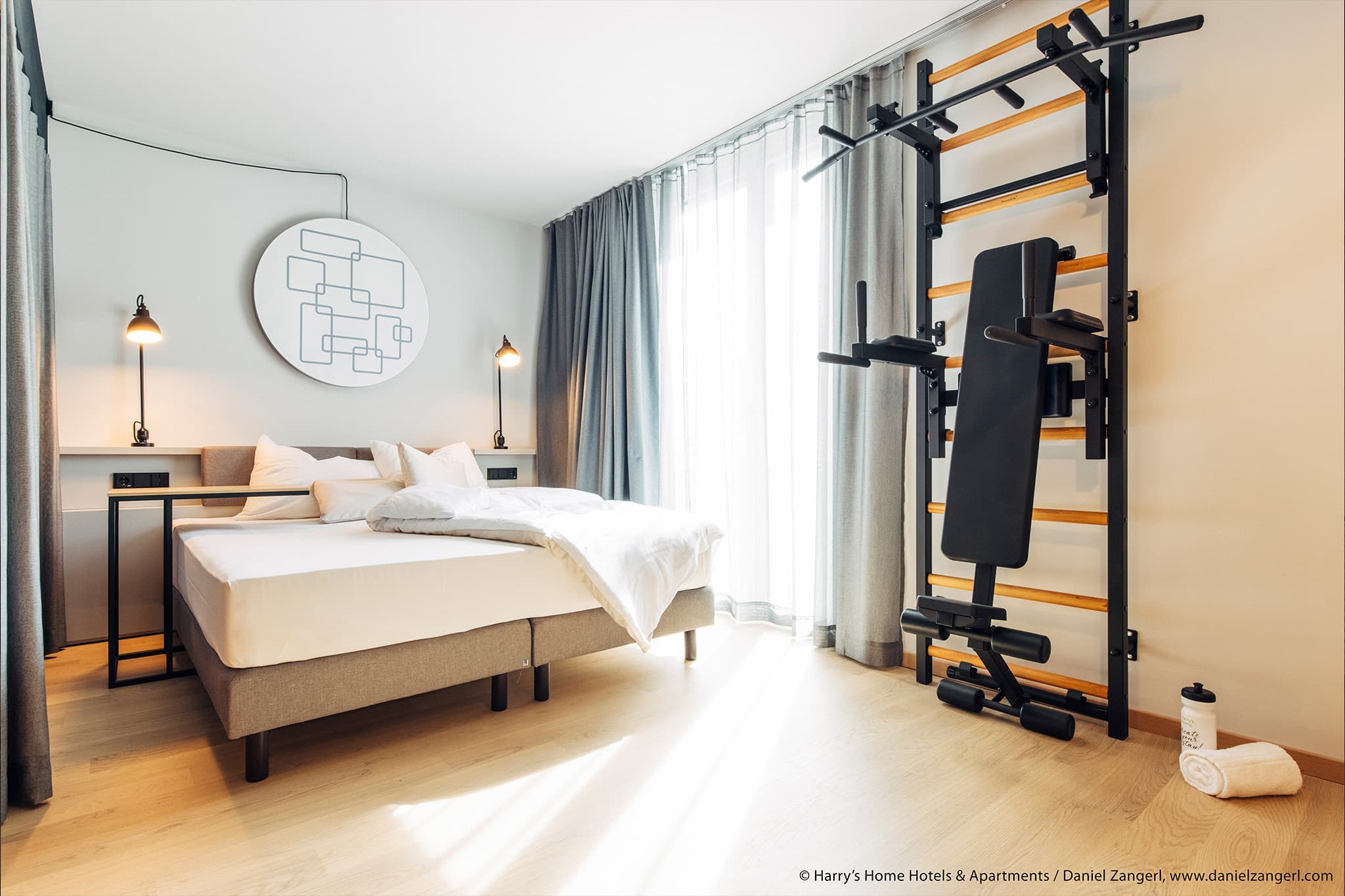
Harry's Home Hotels in Austria understood this early. They equipped 70 rooms with BenchK wall-mounted training systems — not just the fitness center, but individual guest rooms. The wall bars became part of the hotel's visual identity. Guests photograph them. They mention them in reviews.
What equipment should a hotel fitness center include?
Tier 1 — Essential (every hotel)
| Floor space | Guest accessibility | |
|---|---|---|
| Treadmill | 20–30 sq ft | Universal — most-used hotel gym equipment |
| Dumbbells (5–50 lb) | 10–15 sq ft | Moderate |
| Yoga mats + blocks | 0 sq ft stored | Universal |
Tier 2 — Differentiation (boutique/lifestyle)
| Floor space | Guest accessibility | |
|---|---|---|
| Wall-mounted training system | 0 sq ft | Universal — stretching to advanced training |
| Wall-mounted suspension trainer | 0 sq ft | Moderate to advanced |
| Kettlebells | 3–5 sq ft | Moderate |
Tier 3 — Premium (luxury/wellness-focused)
| Floor space | Guest accessibility | |
|---|---|---|
| Smart bike (Peloton class) | 12–15 sq ft | Universal |
| Rowing machine | 20–25 sq ft | Moderate |
| Cable machine | 20–30 sq ft | Advanced — often requires instruction |
Tier 2 equipment delivers the highest value per square foot because it takes zero floor space while serving the widest range of fitness levels.
How wall-mounted systems work in hotels
A BenchK 722B ($1,699) includes wall bars with 9 rungs, a steel pull-up bar, and a dip bar — all wall-mounted. Add a Recoil S2 Gym ($429) suspension trainer with permanent mount, and one station covers stretching, pull-ups, dip-bar exercises, 100+ suspension moves, spinal decompression, and core work. Zero floor space when not in use.
The Harry's Home Hotels case study
Harry's Home made a distinctive choice: BenchK systems not just in the fitness center, but in 70 individual guest rooms. Their reasoning:
- Guests use in-room equipment more than gym equipment — the barrier to walk to the hotel gym is higher than stretching on the wall bars in your room
- The aesthetic works in a hotel room — beech wood wall bars on a clean wall look like furniture
- Differentiation — no other hotel chain in Austria was doing this. It became a talking point in reviews and travel media.
What's the ROI of upgrading a hotel fitness center?
Hotel fitness center ROI is indirect — you don't charge per use. But the return shows up:
Guest satisfaction. Well-designed fitness centers measurably improve overall guest satisfaction scores. Fitness quality disproportionately affects business travelers, who spend more and book more nights.
Online reviews.Hotels with positively mentioned fitness centers see increased fitness-related search visibility. Negative gym mentions ("outdated," "broken treadmill") damage overall ratings disproportionately.
Competitive positioning. In markets with 10+ comparable properties, fitness center quality becomes a tiebreaker.
Cost-per-use over lifespan
| Equipment cost | Est. uses/yr | Cost per use | Lifespan | |
|---|---|---|---|---|
| 4x wall bars + Recoil | $8,512 | 3,000–5,000 | $1.70–2.84 | 10+ years |
| 2x treadmills | $6,000–10,000 | 2,000–4,000 | $1.50–5.00 | 5–7 years |
| 2x Peloton bikes | $5,000–6,000 + subscription | 1,500–3,000 | $2.00–5.00 | 3–5 years |
| Cable machine | $5,000–10,000 | 500–1,500 | $3.33–20.00 | 7–10 years |
Wall-mounted systems have the lowest per-use cost over their lifespan — no motors, cables, or subscriptions.
Recommended configuration
Four wall stations. 4x BenchK 722B ($1,699 each) + 4x Recoil S2 Gym ($429 each). Total $8,512.
Why the 722B: the dip bar adds significant variety beyond bars + pull-up bar. The beech wood + matte steel aesthetic fits hotel interiors. FSC-certified wood, hand-oiled with food-safe oil, powder-coated steel — materials that look and feel premium.
Space math. 4 units = ~9 linear feet of wall. Floor space when not in use: 0. Exercise clearance: 6 feet in front of each station. Fits in almost any hotel fitness center — even a 200 sq ft room.
In-room option.For hotels wanting to follow the Harry's Home approach, the BenchK 200B ($635) is the most space-efficient option — 25 inches of wall width, no accessories needed for basic stretching and hanging.
Making the gym self-service
The biggest operational concern: no staff to show guests how to use equipment. Wall bars handle this better than most:
- Stretching needs no instruction — grip a rung, stretch
- Progressive complexity — basic stretching to pull-ups to suspension training (QR code to videos)
- No adjustment needed — unlike cable machines with pins and pulleys
- Safety by design — no weights to drop, no cables to tangle, no machines to jam. The pull-up bar is self-limiting
Frequently asked questions
What's the minimum hotel gym equipment list?
How much space does a hotel fitness center need?
Are wall bars safe for unsupervised hotel use?
What's the maintenance cost?
How do wall bars fit boutique hotel aesthetics?
Can wall bars go in individual hotel rooms?
What's the total cost to upgrade with wall bars?
Do guests actually use wall-mounted equipment?
Specifying for a clinic, studio, or hotel?
Talk to a commercial specialist. Bulk pricing, mounting guidance, and net-30 terms on three-unit and larger orders.