
Morning Stretch Routine: 10 Minutes on Wall Bars That Replace an Hour of Yoga
A 10-minute morning routine on wall bars can hit every major muscle group and joint — something that takes 45–60 minutes in a typical yoga class. The difference is leverage. Eight stretches, 60–90 seconds each, no flexibility required to start, no special clothing needed.
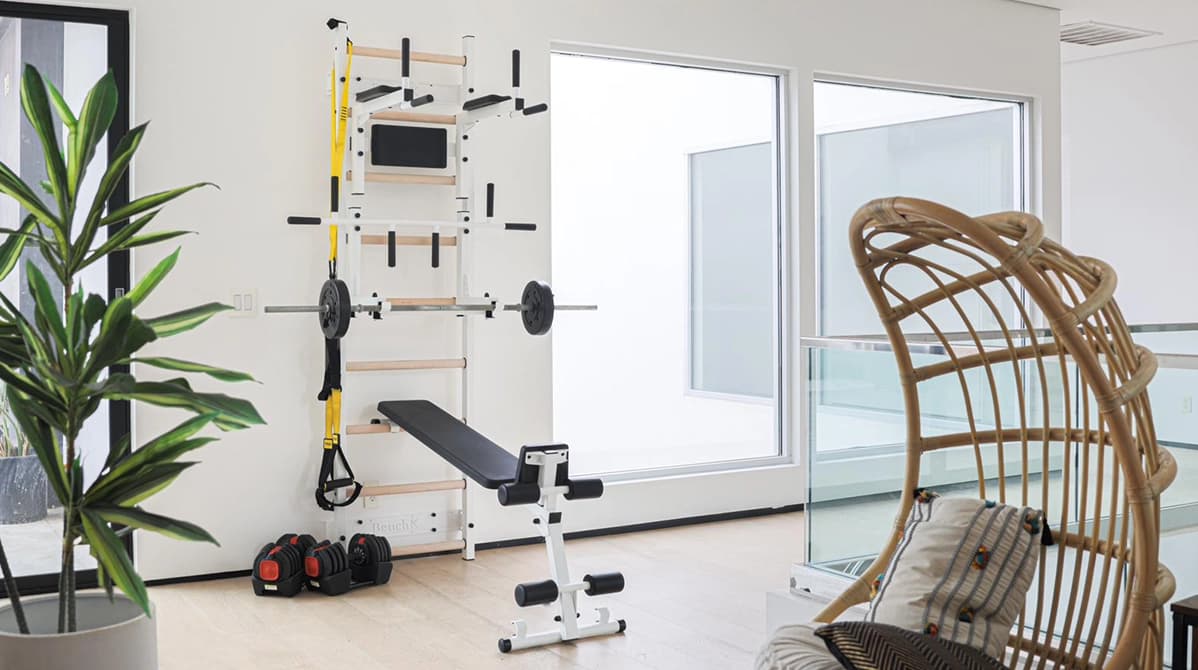
Why wall bars make stretching faster and deeper
Stretching on the floor has a built-in problem: gravity is your only tool, and your range of motion stops at whatever flexibility you have. Wall bars change that:
Gravity-assisted depth.Grip a rung, lean away, body weight creates the stretch. You control depth by grip height and lean. Someone who can't touch their toes can get a deep hamstring stretch on day one by gripping a waist-height rung and hinging forward.
Built-in progression. As flexibility improves, grip a lower rung for more stretch. No blocks, no straps. The progression lives in the equipment.
Stable support.Many good stretches require balance beginners don't have. Holding a rung lets you focus on the stretch, not on not falling.
Research supports the approach: a 2017 International J. Sports Physical Therapy systematic review (Thomas et al.) found static stretching held 30–60 sec per muscle group, done consistently, produced meaningful range-of-motion improvements. Every stretch here holds 60–90 sec.
The 10-minute routine: 8 stretches
Do these in order. Each flows into the next. Total: 9–12 minutes. 8–12 slow breaths per stretch is roughly 60–90 sec.
1. Spinal decompression hang (60 sec)
Targets: entire spine, shoulders, grip.
Face the wall bars. Grip the highest rung you can reach comfortably (or the pull-up bar). Let knees bend and hips drop, body weight gently tractions your spine. Partial hanging with toes on the floor works and is where most people start.
2. Chest and shoulder opener (60 sec — 30 per side)
Targets: pectorals, front shoulders, biceps.
Stand sideways to the bars. Extend the arm closest to the bars behind you and grip a rung at shoulder height. Rotate body away until you feel a deep stretch across the chest and front of shoulder. Switch sides.
3. Hip flexor stretch (90 sec — 45 per side)
Targets: hip flexors (psoas, iliacus), quads.
Face away from the bars. Place the top of one foot on a rung behind you at about knee height (Bulgarian split-squat position). Step the other foot forward into a lunge. Let hips sink down and forward. Grip a rung with one hand for balance.
The single most impactful stretch for anyone with a desk job.
4. Hamstring stretch (90 sec — 45 per side)
Targets: hamstrings, lower back.
Stand facing the bars. Lift one leg and place heel on a rung at a comfortable height — start at waist level. Keep the standing leg straight. Hinge forward with a flat back. Grip a higher rung with your hands.
5. Lateral side stretch (60 sec — 30 per side)
Targets: obliques, lats, intercostals.
Stand sideways to the bars. Grip a rung overhead with the hand closest to the bars. Step feet slightly away and let hips push toward the bars while upper body arcs in the opposite direction. Deep stretch from hip to armpit.
Nearly impossible to replicate on the floor with the same depth.
6. Thoracic spine rotation (60 sec — 30 per side)
Targets: mid-back, obliques.
Stand facing the bars at arm's length. Grip a rung at shoulder height with both hands. Keep hips square. Rotate upper body to one side, opposite hand slides to a nearby rung. Return and rotate to the other side.
The stretch where most people say "oh, that's what was tight."
7. Calf stretch (60 sec — 30 per side)
Targets: gastrocnemius, soleus.
Face the bars. Place the ball of one foot on the lowest rung with heel resting on the floor. Grip a chest-height rung. Lean forward gently, stretching leg straight.
8. Full-body hang and breathe (60 sec)
Targets: everything — reset.
Return to the hang. Focus purely on breathing — 4-count inhale, 4-count exhale. Bookends the routine. You started compressed; you're now decompressed.
Done. Go make coffee.
Wall bars vs. floor stretching
| Floor stretching | Wall bar stretching | |
|---|---|---|
| Leverage | Limited by current flexibility | Body weight as adjustable traction |
| Depth control | Reach as far as you can | Choose rung height for exact depth |
| Progression | Need props (blocks, straps) | Move to a different rung |
| Balance | Limits which stretches you can hold | Grip provides stability |
| Time per muscle group | Often 2–3 positions needed | One position, deeper stretch |
| Spinal decompression | Hard to achieve on the floor | Hanging makes it natural |
| Minimum flexibility | Some positions require existing flexibility | Rung height adapts to you |
A 2019 Journal of Strength and Conditioning Research study (Behm et al.) found regular static stretching — even brief sessions — produced cumulative flexibility improvements over time. The key was consistency, not session length. A 10-minute routine you actually do every morning beats a 60-minute class you attend twice a month.
What wall bars you need
BenchK 200B ($635). Base Series 2 wall bars. Eight beech rungs, steel frame, 150 kg capacity. Covers everything in this routine. No pull-up bar needed for stretching alone.
BenchK 211B ($915). Same plus an adjustable beech pull-up bar. The pull-up bar improves the spinal decompression hangs (stretches 1 and 8) and opens up strength training if you ever want to add pull-ups. For most people, this is the better pick.
Making it stick
- Anchor it to an existing habit. Stretch after you use the bathroom, before you start the coffee maker.
- Start with 5 minutes. First two weeks, do only stretches 1, 3, 4, and 8 — spine, hip flexors, hamstrings, closing hang.
- Count breaths, not seconds. 8 slow breaths ≈ 60 sec. Calmer than staring at a timer.
- Expect day 4 to feel different. Most people notice meaningful change in their back and hips within the first week.
- Wear whatever. Pajamas, boxers, gym shorts, work pants. No floor work, no audience.
Frequently asked questions
Does 10 minutes of stretching really replace yoga?
Do I need to be flexible to use wall bars for stretching?
How soon will I notice a difference?
Should I stretch in the morning or evening?
Can this help with back pain?
What wall bars do I need?
See the system in full.
Configure your BenchK — wall bar, attachments, and accessories — and ship anywhere in the U.S.