
School PE Equipment for the 21st Century: Beyond Dodgeball
The standard American PE class has barely changed since the 1970s. Meanwhile, childhood obesity has tripled since 1975, motor skills among kids 6–12 have measurably declined, and PE participation drops off a cliff in middle school. The equipment hasn't kept up — and Europe figured this out 200 years ago.
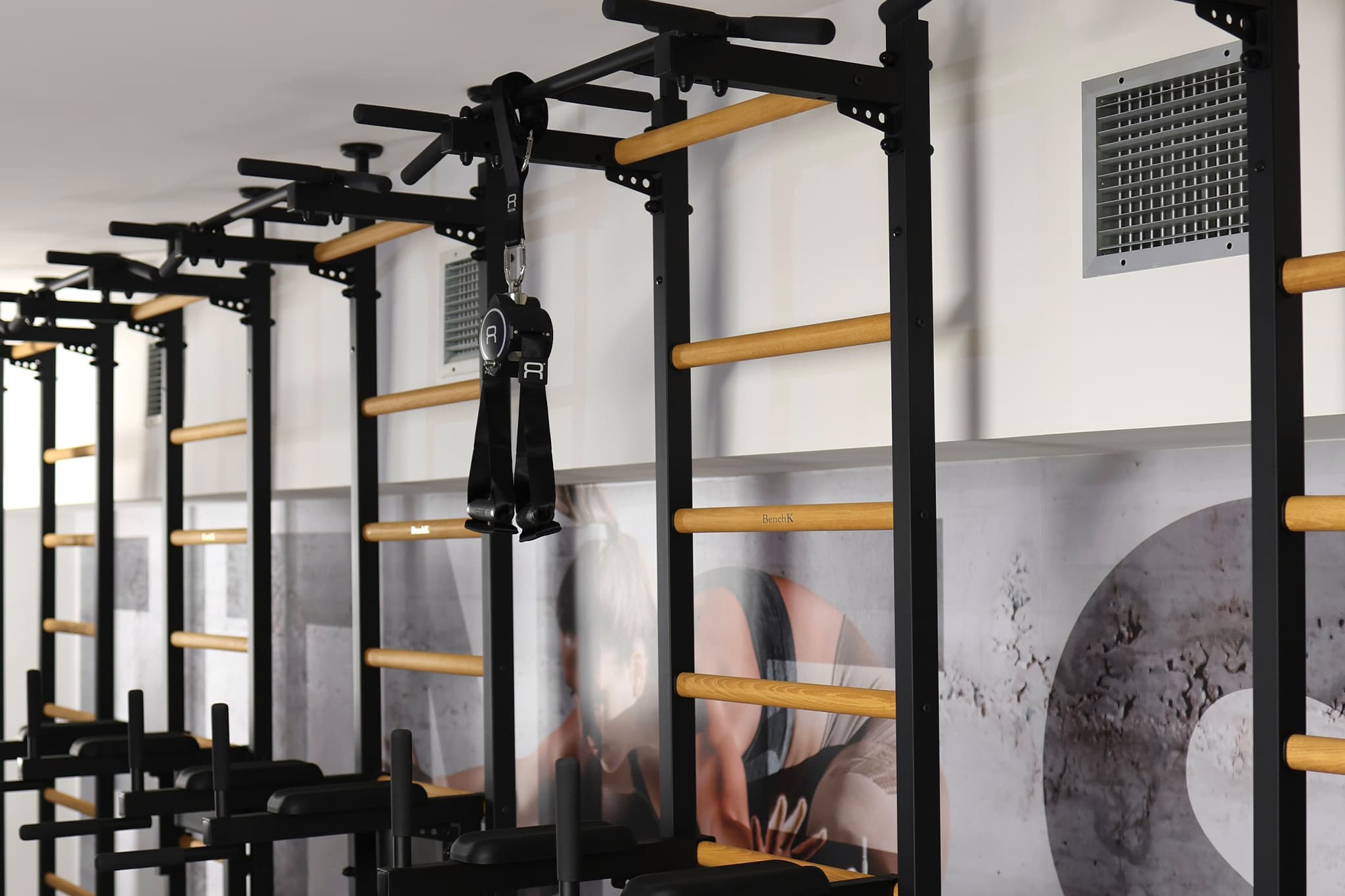
Why most school gyms still look like 1985
Walk into the average American school gym: a rack of dodgeballs, some cones, jump ropes, maybe a climbing rope gathering dust. The equipment isn't the root problem — the root problem is that American PE grew around two activities: team sports and fitness testing. Team sports mean 5–8 kids active while 15–20 watch. Fitness testing means mile runs and sit-and-reach tests that tell kids they're bad at exercise.
According to SHAPE America, only ~24% of children ages 6–17 get the recommended 60 minutes of daily physical activity. PE class — where every child should move — often contributes less movement than recess.
And the stakes just changed: the Presidential Fitness Test returns to schools in fall 2026 — voluntary for public schools, with the pull-up back on the scorecard. Schools that opt in will need pull-up stations. See the 2026 Presidential Fitness Test standards for the verified benchmarks and what they mean for equipment planning.
What European schools figured out 200 years ago
In 1813, Per Henrik Ling established the Royal Central Institute of Gymnastics in Stockholm. His system was built around equipment most Americans have never seen in a school: wall bars (ribbstol in Swedish, Sprossenwand in German). Walk into a school gym in Germany, Sweden, Poland, Finland, or the Czech Republic today and you'll see wall-mounted wooden ladders lining the gymnasium walls. They've been there since the mid-1800s.
The math European PE teachers have known for generations:
- One basketball court: 10 players active, 20 watching
- One set of wall bars (8 units along a wall): 8–16 students active simultaneously
- Each student has their own station — climbing, hanging, stretching, strength exercises
- Rotate every 3 minutes: every student hits every station in a 30-minute class
The stations-based PE model — 8 stations
1. Climbing. Students climb the bars to the top and descend. Grip strength, upper-body endurance, spatial awareness, confidence. Scales — beginners climb to the third rung, advanced go full height.
2. Rope climbing. Gymnastic rope on the pull-up bar. Pulling strength, coordination, determination. Progression: feet-assisted, legs-only hang, full climb.
3. Gymnastic rings. Suspended from the pull-up bar. Shoulder stability, core control, proprioception. Dead hang, tuck hold, swing, skin-the-cat.
4. Stretching & flexibility. Students use rungs at different heights for hamstring stretches, hip openers, shoulder mobility. Fixed rungs provide stable hand and foot holds at progressive heights.
5. Hanging & decompression.Students hang from the pull-up bar or upper rungs. Grip and spinal health. Research on brachiation (Latimer & Lovejoy, 1989) suggests overhead hanging supports shoulder development in children.
6. Bodyweight strength. Incline push-ups (hands on rung), body rows (feet on floor), leg raises. Difficulty scales by changing rung height.
7. Balance & coordination. Standing on lower rungs, single-leg holds, traversing sideways. Develops proprioception — the skill that declines when children spend most of their time sitting.
8. Swing/play station. The wooden swing from the gymnastic accessories. Vestibular sense, core stability, and something we usually skip in PE planning: joy. Joy is what keeps kids coming back.
Why engagement changes everything
In a traditional PE class, a student might be active for 12–15 minutes of a 45-minute period (McKenzie et al., 2006). Stations-based PE pushes that to 25–35 minutes because there's no standing in line, no waiting for a turn, no elimination games that bench the least athletic kids first.
SHAPE America's recommendation is clear: PE should provide moderate-to-vigorous physical activity (MVPA) for at least 50% of class time. Most PE classes fall short (Institute of Medicine, "Educating the Student Body," 2013).
Motor skills: the argument PE directors should make to boards
Children today have measurably worse fundamental motor skills than children 20–30 years ago (Hardy et al., Sports Medicine, 2013). Less outdoor play, less unstructured movement, more screen time. The consequence matters for PE: students arrive without the movement foundation previous generations built on playgrounds and climbing trees.
Wall bars address this directly. Climbing develops bilateral coordination. Hanging develops grip strength and shoulder stability. Rings develop proprioception. Rope climbing develops pulling patterns. A 2021 Journal of Sports Science & Medicine study (Fühner et al.) found children in climbing-based activities showed significant improvements in grip strength, upper-body endurance, and coordination compared to traditional PE.
Budget math for school procurement
| Cost | Students active simultaneously | |
|---|---|---|
| Dodgeball set (24) | $150–$300 | 10–20 in a game |
| Jump ropes (30) | $200–$400 | 30 limited variety |
| Folding mats (10) | $1,500–$3,000 | 10–20 |
| Cones (50) | $50–$100 | Marking, not activity |
| Resistance bands (30) | $300–$600 | 30 |
| Climbing rope (1) | $200–$400 | 1 at a time |
| Total | $2,400–$4,800 | Mostly 10–20 at a time |
| Cost | Students active simultaneously | |
|---|---|---|
| 8x BenchK 211B + A076 (bars + pull-up + gymnastic accessories) | $9,112 | 8–16 (all active, all the time) |
Option B costs more upfront. Here's why the math works over time:
Lifespan. Wall bars in European schools commonly last 20–50 years. BenchK units carry a 10-year warranty on metal. Traditional PE equipment needs replacement every 3–5 years. Over 20 years, Option A costs $9,600–$19,200 in replacements. Option B costs $9,112 once.
Maintenance. Wall bars are mounted to the wall. No inflation, no storage bins, no tangled jump ropes, no torn mats.
Space. Wall bars mount flat. Zero floor space. Gym floor stays clear for basketball, assemblies, dances.
Activity density. 8 stations × 2 students = 16 in active movement simultaneously. A traditional PE class might have 4–8 active during a team sport.
Funding sources
PE equipment purchases commonly qualify for:
- Carol M. White Physical Education Program (PEP) grants — federal funding specifically for PE equipment and programming
- Title IV, Part A funds — Well-Rounded Education funds covering PE equipment supporting health education
- State-level PE grants — vary by state; many states have dedicated PE improvement funds
- PTA/PTO fundraising — wall bars are a visible, permanent improvement
- Corporate wellness partnerships — local businesses sometimes fund school fitness improvements
What each unit includes
Each BenchK 211B + A076 station ($1,139 per unit):
- Wall bars — Series 2, steel frame with FSC-certified beech rungs, 150 kg (330 lb) capacity
- Adjustable beech pull-up bar — height-adjustable, safer for children's hands than steel
- Gymnastic accessories (A076) — cotton climbing rope with wooden swing + adjustable gymnastic rings
The beech wood matters: warmer to the touch than metal (important in unheated gymnasiums), natural grip, meets PN-EN 913:2019 safety standards. The 150 kg capacity means units serve students of all sizes, plus adult use for teacher fitness programs, community recreation hours, and adaptive PE.
Installation and space
- Wall height — minimum 240 cm (94.5") ceiling, standard in most school gyms
- Wall type — concrete, solid brick, or reinforced wall. Wood stud frame requires WHB+S8 ($289)
- Wall width per unit — 67 cm (26.4"). 8 units need ~18 ft continuous wall
- Spacing between units — 30–50 cm (12–20") for safe use
- Total wall space for 8 units with spacing — ~26–30 ft
Common objections from school boards
"We already have a climbing rope." One rope serves one student at a time. Eight stations serve 16 simultaneously.
"Wall bars are old-fashioned."They're old. That's the point. They've been the backbone of European school PE for 200 years because they work for every age and ability.
"Our gym is multi-use." Wall bars mount flat against the wall. Zero floor space. The floor remains completely available.
"What about liability?" BenchK meets PN-EN 913:2019 and carries 150 kg load ratings. Fixed hand and foot holds at predictable heights — arguably more controlled than free-moving equipment.
Pilot program approach
Phase 1 (Year 1). 2–4 units — $2,278 to $4,556. Install along one gym wall. Run stations-based PE mixing wall bar stations with traditional floor stations. Measure engagement, MVPA time, teacher feedback.
Phase 2 (Year 2). Expand to 6–8 units. Apply for PEP grant or Title IV funding using pilot data.
Phase 3 (Year 3+). Add additional schools. District-level procurement based on documented outcomes.
Frequently asked questions
How many students can use wall bars at once?
What age range are wall bars appropriate for?
Are wall bars safe for schools?
How long do wall bars last?
Do wall bars take up floor space?
How do wall bars help with childhood obesity?
What's the total cost for a school gym setup?
Can wall bars be used for adaptive PE?
Specifying for a clinic, studio, or hotel?
Talk to a commercial specialist. Bulk pricing, mounting guidance, and net-30 terms on three-unit and larger orders.