
Shoulder Decompression Exercises at Home: A Complete Guide
Shoulder decompression uses gravity, progressive stretching, and controlled hanging to create space in the shoulder joint and relieve impingement symptoms. The most effective home approach combines dead hangs, assisted overhead stretches, and progressive loading at multiple heights — exactly what wall bars provide.
Why your shoulders hurt (and why stretching alone doesn't fix it)
The subacromial space is roughly the thickness of your pinky finger. When you spend years hunched over a keyboard with rounded shoulders, that space gets even smaller. Tendons and bursa get pinched. Doctors call it impingement.
Simple stretching feels good for about 20 minutes. Then tightness returns. Stretching alone doesn't address the real problem: the joint needs to be decompressed — pulled apart gently — AND the muscles around it need to be strengthened in their lengthened position.
Dr. John Kirsch, a board-certified orthopedic surgeon, proposed that regular hanging from an overhead bar can increase subacromial space over time, based on his clinical observations with hundreds of patients (Shoulder Pain? The Solution & Prevention, 2017). His protocol: dead hangs for 30 seconds to several minutes daily. For the full evidence review — what's supported, what isn't, and his exact prescription — see our Kirsch hanging protocol deep dive.
What makes wall bars ideal for shoulder decompression
Most people try shoulder decompression with a doorway pull-up bar. That gives you exactly one height — full overhead. For someone with shoulder impingement, jumping straight to a full overhead hang on day one is often painful.
Wall bars offer rungs at every height from your waist to overhead. You can start with hands at chest height, feet planted, leaning back gently. Over weeks, work one rung higher. Then another. This matches exactly how physical therapists work with shoulder patients — they never start with full hanging.
Beginner level (Weeks 1–3)
1. Standing wall-bar lean-back. Face the bars. Grip a chest-height rung. Step feet forward about 18″. Lean back with straight arms — gentle stretch opens shoulders and lats. Hold 20–30 sec, 3 times. Your day-one exercise.
2. Side-facing shoulder opener. Stand sideways. Grip a shoulder-height rung with the arm closest to the wall. Rotate away until you feel a deep stretch across the chest and front of shoulder. Hold 20 sec, switch sides.
3. Assisted dead hang (feet on ground).Face the bars. Grip a rung at head height. Keep feet on the ground, slowly bend knees, let body weight decompress. Feet carry 50–70% of your weight — you're in control. 15–30 sec, 5 times.
4. Cat–cow at the wall.Grip a waist-height rung with both hands. Alternate arching (cow) and rounding (cat). Ten slow reps. Thoracic immobility is a hidden driver of shoulder impingement (Theodoridis & Ruston, 2002).
5. Wall-bar snow angels. Back against the bars. Arms at sides, palms forward. Slide arms up — touching each rung — until overhead, then back down. Tactile feedback for whether arms stay flat against the wall. 8–10 reps.
Intermediate level (Weeks 3–6)
6. Progressive dead hang (one rung higher each week). Start at chin-height rung with feet on the ground. Each session or every few, move grip one rung higher. Eventually reach the top rung with feet barely touching. Gradually reduce foot support. 20–45 sec, 3–5 sets.
7. Single-arm hang (assisted). Forehead-height rung, one hand. Both feet on floor. Shift weight toward that arm. 15–20 sec each side.
8. Rung-to-rung traverse. Hang with feet on the ground for support. Move one hand up a rung, then the other, then back down. 3–5 passes.
9. External rotation stretch. Forearm horizontally against a rung at elbow height, elbow bent 90°. Turn body away keeping forearm pinned. Targets the infraspinatus and teres minor. 20 sec each side.
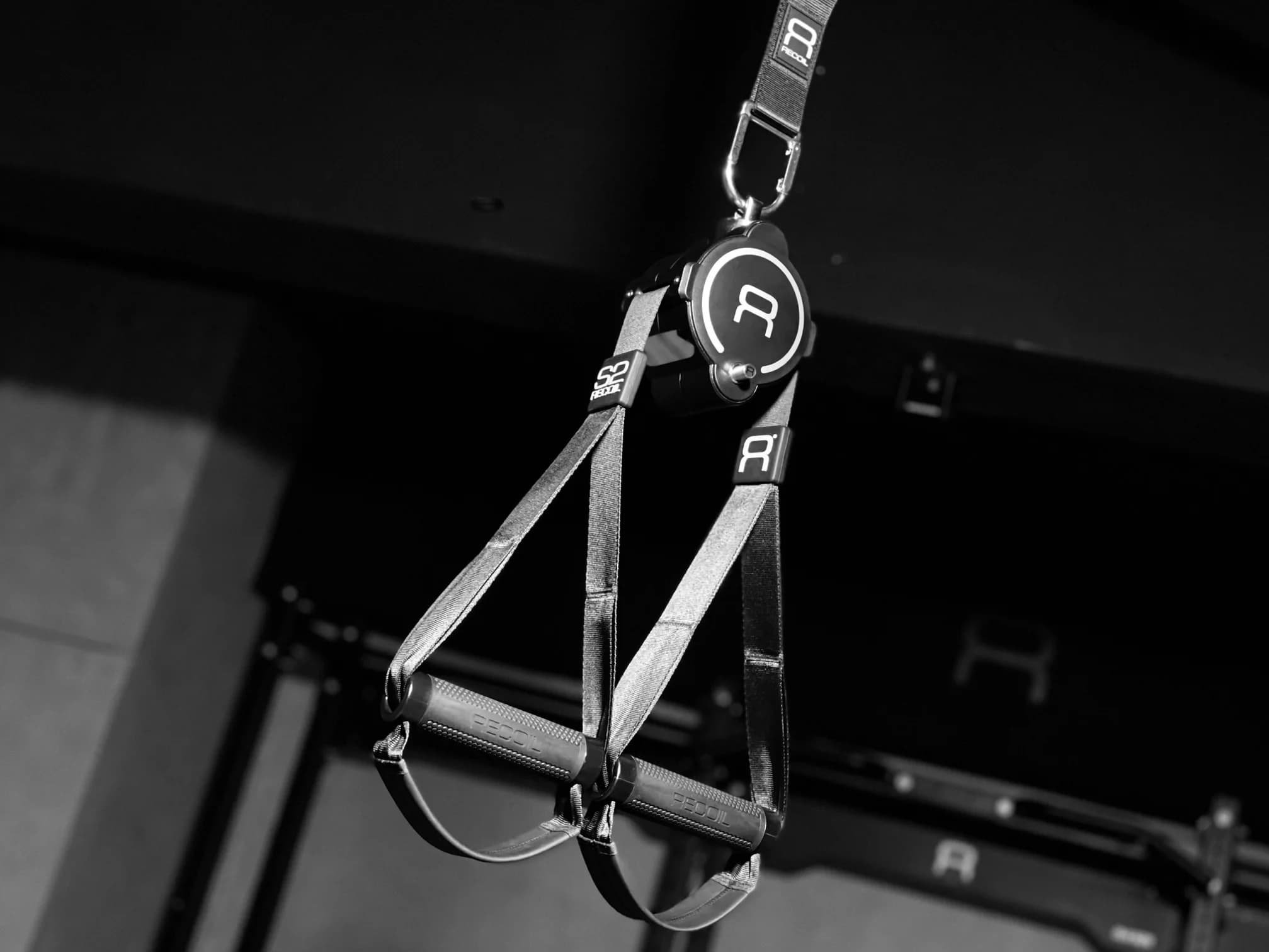
10. Suspension-assisted shoulder circles. Recoil S2 attached to a rung. Hold handles at chest height. Lean back slightly, slow controlled circles. Ten each direction.
Advanced level (Weeks 6+)
11. Full dead hang.Hang from the pull-up bar or top rung. Feet off the ground. Relax shoulders. Start with 10–15 sec, build toward 60. Kirsch's recommendation: accumulate 1–3 min of total hanging per session.
12. Active hang to scapular pull-up. Hang. Without bending elbows, engage shoulder blades — pull them down and together. Body rises slightly. Hold 3 sec at the top. 8–12 reps. Strengthens the lower trap and serratus anterior in their lengthened position — unglamorous, and it matters more than almost any other shoulder exercise.
13. Skin-the-cat progression. Slowly raise legs tucking knees to chest, continue rotating backward until feet point toward floor behind the bar. Reverse. Tuck before straight legs. Only after 60 sec dead hang without pain. 3–5 reps.
14. Suspension overhead stretch. Recoil S2 handles at lowest position. Face away from anchor, step forward until arms extended overhead and behind. Straps support arms, gravity decompresses. 20–30 sec.
A sample weekly program
| Exercises | Time | |
|---|---|---|
| Monday | 1, 2, 3, 5, 9 | 15 min |
| Tuesday | 4, 6, 10 | 12 min |
| Wednesday | Rest or gentle mobility | — |
| Thursday | 1, 7, 8, 9 | 15 min |
| Friday | 6, 10, 11, 12 | 15 min |
| Weekend | Any 3 exercises that feel good | 10 min |
Beginner exercises only during Weeks 1–3. Add Intermediate during Weeks 3–6. Add Advanced from Week 6 at the earliest. One rule: if any exercise causes sharp pain — not the discomfort of a good stretch — stop. Skip it for a week before retrying.
Why wall bars beat alternatives for this use case
| Progressive loading | Multiple heights | Shoulder-specific | Floor space | |
|---|---|---|---|---|
| Doorway pull-up bar | No | One height | Limited | Minimal |
| Power tower | Limited | 1–2 heights | Limited | 12–20 sq ft |
| Inversion table | No | N/A — spinal only | Not shoulder-specific | 15 sq ft |
| Wall bars (BenchK 211B) | Yes — 9 heights | Yes | Excellent | <11 sq ft wall, 0 floor |
| Suspension trainer | Infinite angle | Adjustable | Very good | Door mount or wall anchor |
The critical advantage: intermediate heights. If full overhead hanging hurts today, you need a lower grip point. A doorway pull-up bar can't give you that. Wall bars can.
What equipment you need
Minimum — BenchK 211B ($915). Series 2 wall bars with the beech pull-up bar. 8 rungs plus the adjustable bar = 9 grip heights. 150 kg capacity. The beech wood rungs are noticeably easier on hands than cold steel.
Ideal — add Recoil S2 Home ($429). Total $1,344. The Recoil clips onto any rung; the included door mount lets you continue your routine in a hotel.
Budget — BenchK 200B ($635). Base wall bars without the pull-up bar. Still 8 rungs for progressive decompression. Add the pull-up bar later.
When NOT to do these exercises
Stop immediately and see a doctor if you experience:
- Sharp, shooting pain during any exercise
- Numbness or tingling traveling down your arm
- Inability to lift your arm above shoulder height
- Shoulder pain that wakes you up at night
- Any feeling of instability — like your shoulder might slip
Not appropriate for acute rotator cuff tears, dislocations or instability without PT clearance, frozen shoulder during acute inflammatory phase, post-surgical shoulders without surgeon approval, or labral tears without medical guidance.
Frequently asked questions
How long does it take for shoulder decompression exercises to work?
Can I do shoulder decompression exercises with a rotator cuff injury?
Are wall bars better than a pull-up bar for shoulder rehab?
How much space do wall bars take up?
Can dead hangs really fix shoulder impingement?
Is it safe for older adults to do shoulder decompression exercises?
How often should I do shoulder decompression exercises?
What's the difference between shoulder decompression and spinal decompression?
See the system in full.
Configure your BenchK — wall bar, attachments, and accessories — and ship anywhere in the U.S.