
Suspension Trainer Buyer's Guide: Every Option Compared (2026)
The best suspension trainer in 2026 depends on how you train, where you train, and how much time you want to spend fiddling with straps. The market now spans push-button systems like the BenchK Recoil S2, the TRX lineup that started it all, budget imports under $50, gymnastic rings, and ultralight travel options.
What actually makes one suspension trainer different from another?
Every suspension trainer is, at its core, straps plus handles plus an anchor point. The real differences come down to five things:
- Adjustment mechanism — How fast you change strap length between exercises
- Strap management — Whether loose strap dangles everywhere or stays contained
- Mounting options — Door, wall, ceiling, portable, or all
- Build quality — Materials, weight limits, longevity
- Ecosystem — Training apps, guided workouts, accessories
Adjustment speed matters way more than most buyers think. We'll show the math below.
Full comparison (2026)
| Price | Adjustment | Strap mgmt | Max user weight | Mounts | Warranty | |
|---|---|---|---|---|---|---|
| BenchK Recoil S2 | $399–$459 | Push-button ~2 sec, both straps | Always taut, internal | 330 lb | Door / Wall / Ceiling / Portable | 10yr metal / 2yr other |
| TRX Home2 | $239.95 | Cam buckle 15–30 sec | Dangles when idle | 350 lb | Door (+$70 XMount) | 1 year |
| TRX Pro4 | $289.95 | Cam buckle 15–30 sec | Dangles when idle | 350 lb | Door (+$70 XMount) | Lifetime |
| Budget ($30–50) | $25–$50 | Cam buckle 15–30 sec | Dangles | 200–300 lb | Door | 30–90 days |
| Monkii Bars 2 | $99 | Fixed length | Minimal strap | 250 lb | Portable | 1 year |
| Gymnastic rings | $30–$80 | Manual thread | Dangles | 400–600 lb | Wall / ceiling / branch | Varies |
BenchK Recoil S2 — push-button adjustment ($399–$459)
The only suspension trainer with a patented push-button adjustment. Press the button, pull to length, release. Both straps move together, evenly, every time. About 2 seconds total. Straps stay taut at all times. Excess strap stores inside the unit rather than dangling.
Four variants, same core unit:
- Recoil S2 ($399). Unit + lashing strap. For people who already have a bar, rack, or wall bars to clip onto.
- Recoil S2 Home ($429). Adds a bag with built-in door mount. Throw it over a standard door, close it, train. Best for home + travel.
- Recoil S2 Gym ($429). Adds a permanent Recoil Mount for wall/ceiling. Hex wrench. Best for gyms, clinics, studios.
- Recoil S2 Pro ($459). Everything — door mount, permanent wall mount, lashing strap.
Who should buy. Anyone doing suspension training 3+ times per week who values flow. Circuit trainers especially — changing exercises every 30–60 sec, a 2-sec adjustment vs 20-sec changes the workout feel.
Where it falls short.Costs $160–$220 more than a TRX Home2. Weighs ~4x as much (still portable, but noticeable). Training content library is smaller than TRX's app.
TRX Home2 and Pro4 — the name everyone knows ($239.95–$289.95)
TRX built this category. The Home2 and Pro4 are still the most recognized suspension trainers on the planet.
TRX Home2 ($239.95). Rubber grips, door anchor, 1-year warranty, access to TRX Training Club. The entry point for anyone who wants a proven name.
TRX Pro4 ($289.95). Upgraded Kevlar-stitched construction, locking carabiner, lifetime warranty. The buy-it-once option.
What TRX does well.Two decades of brand trust. TRX Training Club has hundreds of video workouts. Pro4's lifetime warranty is among the best in fitness equipment. At 1.6 lb for the Home2, nothing travels lighter (except Monkii).
What TRX gets wrong.Cam-buckle adjustment is the weak point. Thread, pull, match the other strap manually. 15–30 sec per change. Excess strap dangles below the handles when idle. Once you've used a faster system, it's hard to go back.
Budget suspension trainers ($25–$50)
Amazon lists dozens of kits from brands like WOSS, NOSSK, and unbranded options. $25–$50 typically.
What you get. A functional suspension trainer that does the job. Same cam-buckle adjustment as TRX. Same basic exercises.
What you give up.Consistency. Build quality varies. Weight capacity claims of "300 lb" often don't account for dynamic loading. Warranties are 30–90 days if they exist. No training content.
The honest take.A $35 trainer does ~80% of what a TRX does at ~15% of the price. Use it three times a week for six months — if suspension training is your thing, upgrade with confidence. If it ends up in the closet, you're out $35, not $400.
Monkii Bars 2 — for the gram-counters ($99)
Skips the adjustment mechanism entirely. Fixed-length straps, 12 ounces total weight, fits in your pocket. Reposition your body instead of changing strap length.
Best for. Backpackers, ultra-minimalist travelers, people who want to hang a workout from a tree branch.
Trade-off. No adjustment = fewer exercise variations and a steeper learning curve. 250 lb weight capacity is the lowest on this list.
Gymnastic rings — the original suspension trainer ($30–$80)
Wooden or plastic rings hanging from adjustable straps. Athletes have trained on these since ancient Greece. Unmatched for raw pulling and pushing strength.
Best for. Calisthenics athletes, CrossFit, anyone chasing ring dips, muscle-ups, or an iron cross.
How rings differ.No foot cradles. Much higher stability demands — if you can't hold yourself steady, you can't do the exercise. Steeper learning curve.
Best use. As a complement to a suspension trainer, not a replacement. Many serious trainers own both.
Quick decision guide
Pick the BenchK Recoil S2 if you train with a suspension trainer 3+ times/week, circuit-style workouts are your thing, you own or plan to get BenchK wall bars, or you want a permanent wall/ceiling mount.
Pick TRX if guided workouts matter, you want the most established brand, budget is a primary factor, or every ounce counts for travel.
Pick a budget trainer if you're testing whether you even like suspension training.
Pick Monkii Bars if ultra-light portability trumps everything else.
Pick gymnastic rings if upper-body calisthenics is your primary goal.
The adjustment factor — why 2 sec vs 20 sec matters
A typical suspension trainer workout has 6–10 exercises. Most require different strap lengths. With cam-buckle (TRX, budget): 15–30 sec per strap, twice to match.
The numbers. 8 exercises × 2 adjustments × 20 sec = 5 min 20 sec per workout spent adjusting. Training 200 times a year = ~17.8 hours of strap-fiddling.
Recoil's push-button does the same job in ~2 sec, both straps simultaneously. Same 8 exercises: 16 sec total. Yearly difference: ~17 hours.
Whether 17 hours of saved fiddling is worth $160–$220 depends entirely on you. For someone doing quick 30-min circuits, losing 5 min per session is noticeable. For someone with slow, deliberate exercise, it barely registers.
What about mounting to the wall?
Most suspension trainers are sold as portable — door anchor, carry bag. But a growing number of regular users switch to permanent mounting. Why:
- Same anchor height every time — no variation between door frames or park structures
- Zero setup time
- No door frame stress — door anchors wear on frames over months
- Multiple anchor heights when paired with wall bars
The Recoil S2 Gym ($429) and S2 Pro ($459) include a permanent Recoil Mount. TRX sells the XMount separately for ~$70.
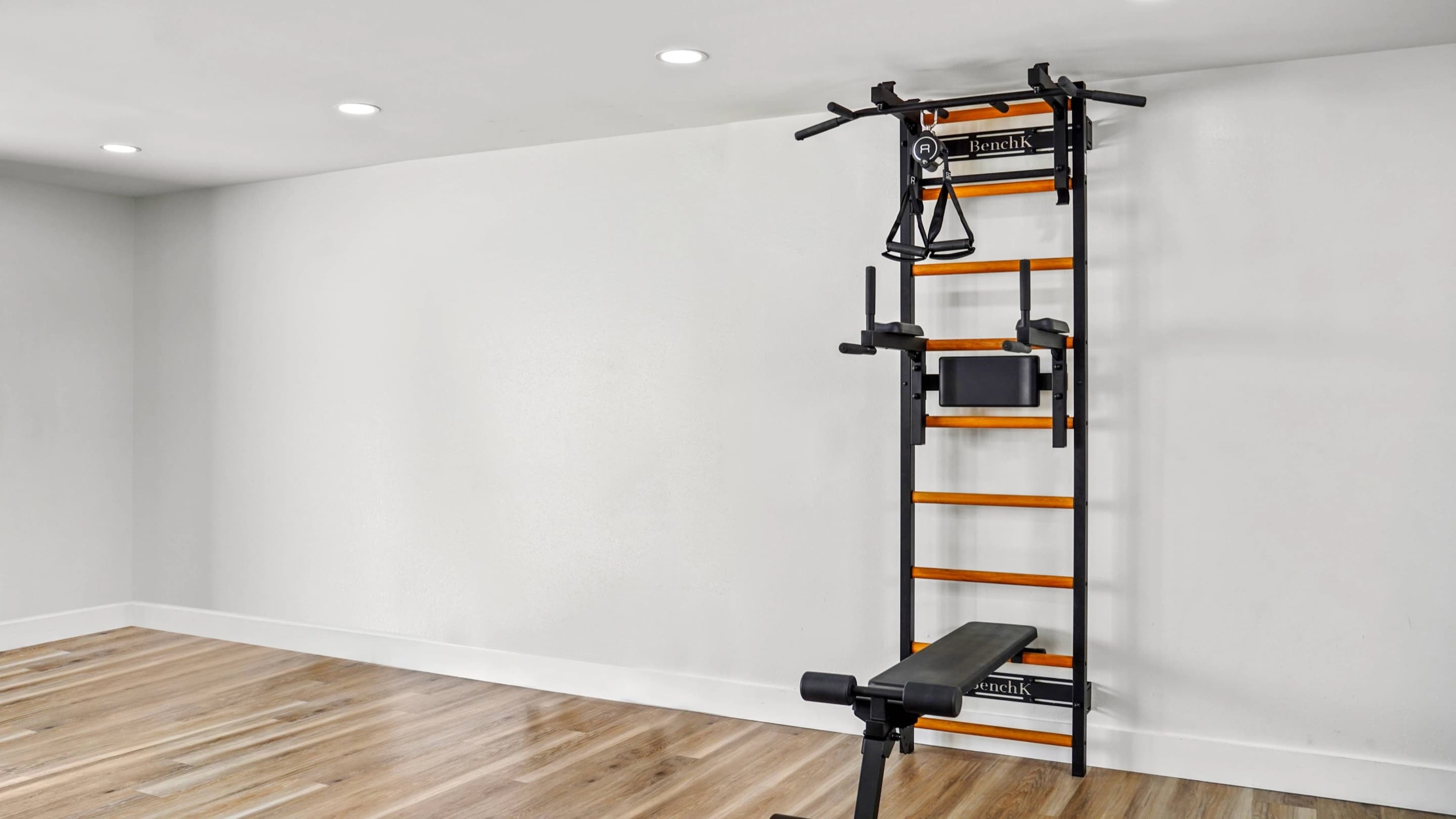
For the most versatile setup, pairing a Recoil S2 with BenchK wall bars gives adjustable anchor height across the full wall bar system. The lashing strap clips to any rung. Push-button strap adjustment + variable anchor height = more exercise options than any single mounting method.
Frequently asked questions
Are suspension trainers worth it for home workouts?
Can you actually build muscle with a suspension trainer?
Is TRX worth the extra money over a cheap suspension trainer?
Is the BenchK Recoil worth $160 more than TRX?
Can a complete beginner use a suspension trainer?
Do I need a door anchor or should I wall mount?
What is the difference between suspension trainers and gymnastic rings?
How long do suspension trainers typically last?
See the system in full.
Configure your BenchK — wall bar, attachments, and accessories — and ship anywhere in the U.S.