
Wall Bars vs Pull-Up Bars: Which Is Better for a Home Gym?
A pull-up bar gives you one exercise. A wall bar gives you a hundred. Here's a clear-eyed comparison — what each is good for, what each costs, and which one belongs on your wall.
What's a pull-up bar good for?
A pull-up bar is the simplest piece of training equipment ever made: a horizontal rod fixed to a wall, ceiling, or doorframe at a height you can hang from. It's cheap (a doorframe model runs $30–$60), it's small, and it teaches one of the most fundamental movements in bodyweight training: the pull-up.
For someone whose entire training program is "I want to do pull-ups," a pull-up bar is enough. It's also enough for:
- Chin-ups and wide-grip pull-ups
- Hanging leg raises
- Dead hangs (great for grip and decompression)
- Toes-to-bar (a CrossFit staple)
That's roughly the entire vocabulary of a pull-up bar. Five movements, one piece of equipment, $50.
Where the pull-up bar runs out of room
The pull-up bar is also where most home gyms stop — and that's the problem. Within six months of buying one, the typical owner runs into the same three walls:
One — there's no progression beyond pull-ups. Once you can do ten clean pull-ups, the bar has nothing else to teach you. You start adding weight to your hips and the doorframe model starts pulling out of the trim.
Two — the rest of your training is unsupported. Push-ups happen on the floor. Dips need a different piece of equipment. Rows need rings or bands. Squats need a rack. The pull-up bar's success at one movement creates demand for five other pieces of equipment that don't exist yet on your wall.
Three — there's nowhere to anchor anything else. Suspension straps, resistance bands, gymnastic rings — all of these train movements the pull-up bar can't, and all of them need an anchor point that a single bar usually can't provide safely.
What a wall bar actually is
A wall bar — sometimes called a stall bar, Swedish ladder, or gymnastic ladder — is a vertical wooden frame with horizontal rungs, mounted directly to a wall. It was invented in 1810 by Per Henrik Ling for Swedish military gymnastics, has been continuously used in European physical education for two centuries, and is the standard piece of equipment in Schroth-method scoliosis treatment worldwide.
At its simplest, a wall bar is just a series of rungs you can hang from at any height. That alone makes it more versatile than a pull-up bar — you can pull, push, row, hang, decompress, anchor, support, and stretch from any of fourteen rungs instead of one bar at one height.
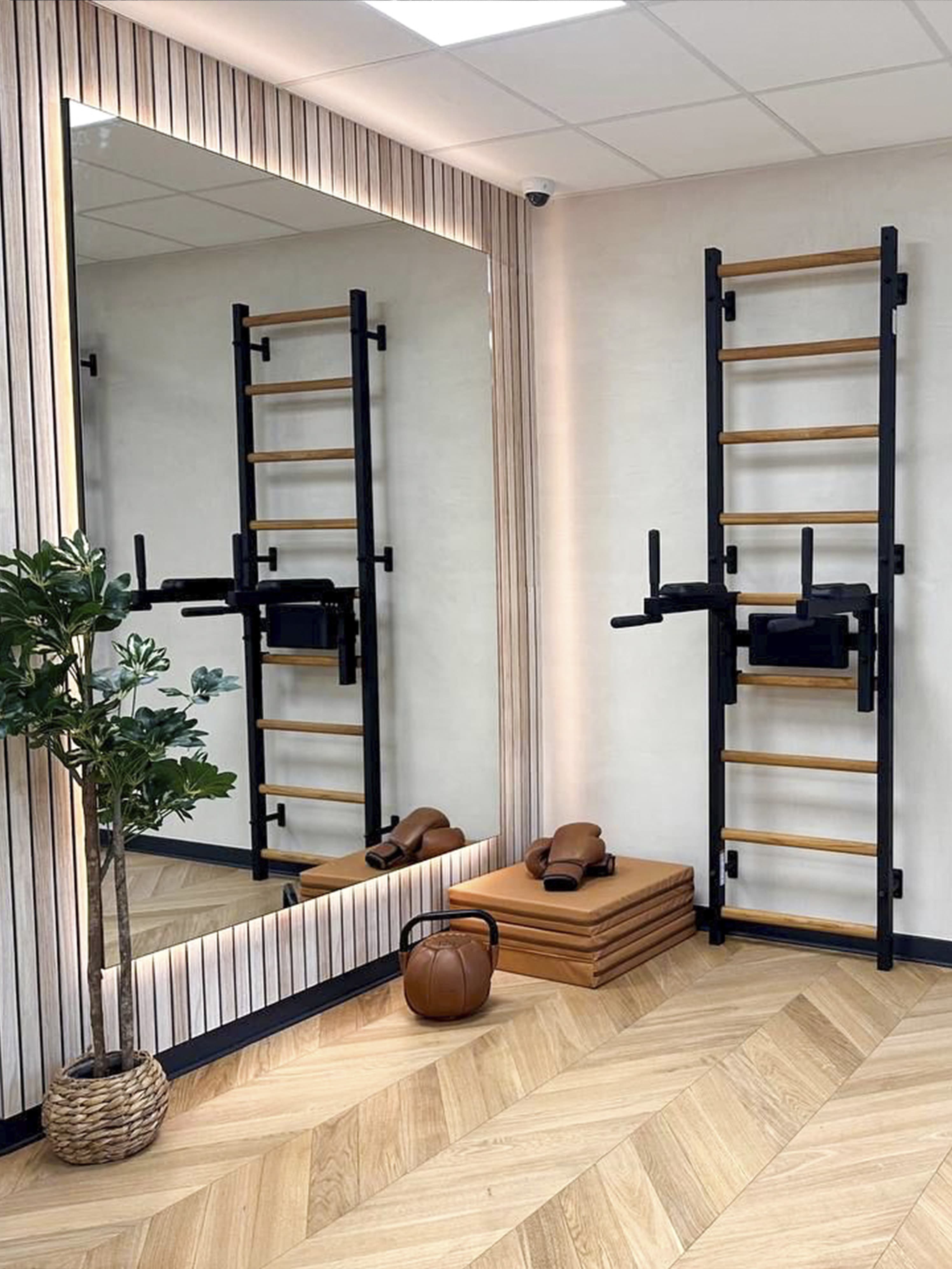
At its most developed — like the BenchK Series 7 with the full attachment system — a wall bar becomes a single wall that does the work of a squat rack, pull-up bar, dip station, bench, suspension trainer, cable system, and barre.
Side-by-side comparison
| Pull-up bar (doorframe) | Pull-up bar (wall-mounted) | Wall bar (BenchK Series 7) | |
|---|---|---|---|
| Price (USD) | $30–$60 | $120–$300 | $1,495–$2,955 |
| Movements unlocked | ~5 | ~7 | 100+ |
| Replaces other equipment | No | No | Pull-up bar, dip station, rower, bench, suspension trainer, barre |
| Suspension-strap anchor | Risky (one bar) | Yes (one bar) | Yes (any rung) |
| Spinal decompression | Yes (limited) | Yes (limited) | Yes (full hangs + supported) |
| Mobility / stretching | No | No | Yes (any height) |
| Children / family use | Risky | Risky | Yes (built for it) |
| Looks acceptable in a living room | No | Sometimes | Yes (designed as furniture) |
| Lifespan | 3–5 years | 10–15 years | 30+ years (10-year warranty) |
Prices reflect BenchK Series 7 wall bar configurations as of May 2026. Pull-up bar prices are typical retail ranges across major US sellers.
The five-pieces-of-equipment math
The strongest argument for a wall bar over a pull-up bar isn't philosophical — it's accounting. A typical "I want a real home gym" equipment list looks like this:
- Pull-up bar — $200
- Dip station — $150
- Adjustable bench — $250
- Suspension trainer (TRX) — $200
- Resistance band set — $80
- Floor space, mounts, and the visual chaos of five separate objects on five different walls
Total: about $880, plus a room that now looks like a gym. A single BenchK Series 7 wall bar with the standard attachment set replaces all of that on one clean wall — and ages like furniture instead of like a Walmart fitness aisle.
For physical-therapy clinics, the math is even more lopsided. The BenchK pitch to PT clinics is explicit: one wall unit replaces TRX, elastic bands, cable systems, parallel bars, balance station, and pulley system — six discrete pieces of equipment from five different vendors.
When a pull-up bar is still the right answer
Wall bars aren't for everyone. A pull-up bar is the better buy if:
- You rent and can't put screws in walls. A doorframe model goes up and comes down without a trace. A wall bar requires permanent mounting through wall studs or load-bearing structure.
- You only train one movement. If your program is "do pull-ups, eventually do more pull-ups," a $50 bar is sufficient. You won't grow into the wall bar's range.
- You travel a lot. Pull-up bars pack down. Wall bars don't move.
- You already have a full home gym. If you have a squat rack, dip station, rings, and a bench, a wall bar is partly redundant — though most home-gym owners who add one find it replaces three or four of those pieces over time.
Where to mount a wall bar
The biggest practical hurdle for new buyers isn't whether to choose a wall bar — it's where to put one. Three rules of thumb:
1. It needs structural wall
Wall bars hang on wood studs (16" or 24" on-center) or on concrete / masonry. Drywall alone won't hold the load. About 99% of US installations are on wooden-stud framing, which means most BenchK orders include the WHB wall holder accessory by default.
2. Plan for height + reach
A standard BenchK wall bar runs about 7 feet tall. That's enough room for a 6'2" user to do dead hangs without touching the ceiling. If you have an 8' ceiling, you have margin. If you have a 7'2" ceiling, the Series 1 (shorter footprint) is the right model.
3. Leave a clear floor zone
The most important specification isn't the wall — it's the floor in front of it. Plan for at least 6' × 8' of clear space for full-range suspension work, dips, and barbell rest. Most installations sit on a hardwood or cork floor; foam tiles work but absorb force less cleanly.
The recommendation
If you're buying your first piece of training equipment and you have $50, buy the doorframe pull-up bar. It's the right tool for that moment.
If you're buying your second piece — or your first piece is now gathering dust — a wall bar is almost certainly the better next purchase than dip bars, a TRX, or a bench. It's the only piece of equipment in this category that gets more useful as you get stronger, more mobile, and more curious about training.
And if you're a Pilates studio, PT clinic, or hotel: there's no equivalent argument. A wall bar replaces four to six pieces of therapy and training equipment, looks like furniture, and lasts thirty years. The pull-up bar isn't in the same conversation.
Frequently asked questions
What's the difference between a wall bar, a stall bar, and a Swedish ladder?
Are wall bars worth it if I already have a pull-up bar?
Can a wall bar replace a squat rack?
How much weight can a wall bar hold?
Can wall bars help with back pain?
Do I need to drill into studs?
How tall is a typical wall bar?
Why don't more Americans know about wall bars?
Build your wall.
Choose a series, size your space, and add the attachments you need — we'll quote it before you check out.