
What Is Wall Pilates — And What Equipment Actually Makes It Work?
Wall Pilates became the most searched workout in America in 2023. Here's what it actually is, what the science says, where the limits are, and what equipment exists for people who want to keep going beyond a flat wall.
How did Wall Pilates get so popular?
Wall Pilates blew up on TikTok in 2023, accumulating tens of millions of views under #WallPilates (some estimates put the total above 400 million across related content). Google named it the most-trending workout search of that year. The appeal was simple: a full Pilates-style workout at home, with zero equipment, in 15 to 20 minutes.
The 28-day wall Pilates challenge format spread fastest, with Rachel's Fit Pilates and dozens of other creators driving millions of YouTube views. It tapped a real frustration: people wanted Pilates but couldn't stomach $30–$60 studio classes or $1,500–$6,000 reformers. A flat wall costs nothing.
What exercises can you do with just a wall?
A flat wall gives a stable vertical surface for bodyweight exercises. Most wall Pilates routines include 15–25 variations:
Lower body
- Wall sits (static and pulsing)
- Wall-supported squats and single-leg squats
- Glute bridges with feet on the wall
- Hamstring walks, leg circles, inner-thigh squeezes
Core
- Wall roll-downs and standing pelvic tilts
- Wall planks
- Dead bugs with feet against the wall
- Side planks with hand on the wall
Upper body & posture
- Wall push-ups
- Chest expansion with wall support
- Scapular slides and wall angels
Does Wall Pilates actually work? What the research says
No published study uses the term "wall Pilates" — it's a social-media coinage, not a clinical category. But the underlying components all have evidence:
Pilates for back pain. A 2014 PLOS ONE meta-analysis (Wells et al., 14 RCTs) found Pilates-based exercise produced significant improvements in pain and functional ability for chronic low back pain at 4–15 weeks.
Isometric exercise & blood pressure. The British Journal of Sports Medicine (Edwards et al., 2023) found isometric exercise reduced resting systolic BP by 8.24 mmHg — the most effective exercise type for blood-pressure reduction.
Balance in older adults. Archives of Physical Medicine and Rehabilitation (Barker et al., 2015) found Pilates significantly improved static and dynamic balance — critical for fall prevention.
Where does Wall Pilates hit its ceiling?
A flat wall is a starting point, not a destination. After a few weeks you'll run into the same four limits:
No progressive resistance.Once a wall sit feels easy, you're stuck. You can slow tempo or add holds, but there's no way to meaningfully increase load.
No grip points.You can't hang from a flat wall. You can't position hands or feet at different heights. You can't anchor for rotational work.
Limited range of motion. Some wall-Pilates exercises actually make the movement easier than the free-standing version — a wall-supported squat reduces balance and stabilization demand rather than progressing it.
Roughly 15–25 variations. A reformer offers 50+. A wall bar offers 100+. A bare wall runs out of options fast.
At a certain point you won't be able to progress much only using a wall as a prop, since you can't turn up the resistance or change elevation to increase intensity. — Mary Wolff, Certified Pilates Instructor
What are wall bars — and why do Pilates pros use them?
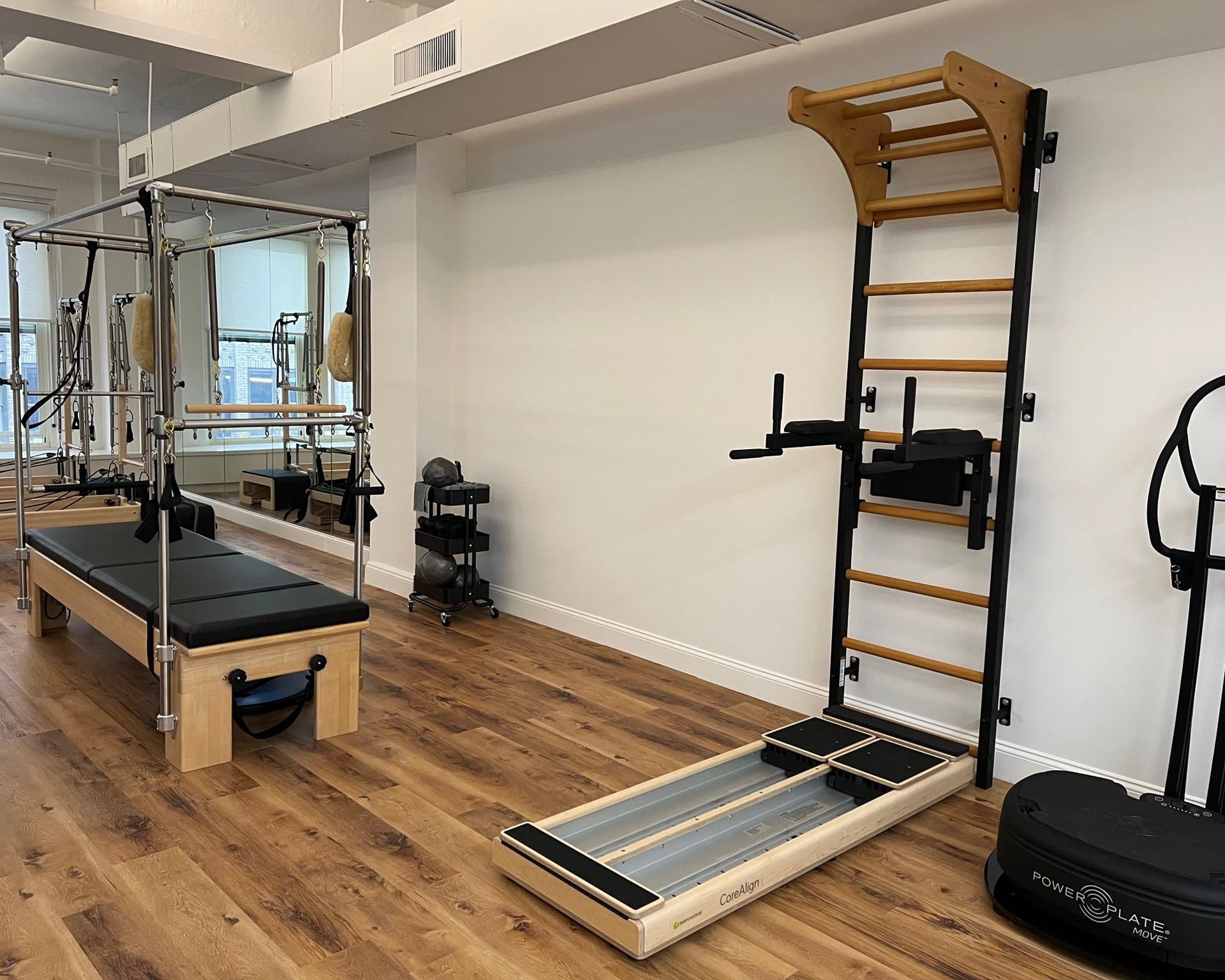
Wall bars (Sprossenwand in Germany, espalier in France) are wall-mounted ladder-like frames of wood or steel rungs. Per Henrik Ling invented them in Sweden around 1813 as part of his therapeutic-movement system. They became standard in European schools, gymnasiums, and physio clinics over the next two centuries.
The Pilates connection isn't accidental. Joseph Pilates grew up in Germany, where wall bars were in every school gymnasium. His father was reportedly the equipment manager at a Turnverein, a German gymnastics club where wall bars were foundational.
Today Pilates studios and PT clinics across Europe use wall bars for exercises a reformer can't replicate — hanging work, vertical stretching, spinal decompression. In the US, Peak Pilates now sells BenchK systems; Praxis Pilates in New York uses BenchK units for group and private sessions.
What exercises open up on wall bars?
Hanging & decompression
- Passive hang — grip an upper rung, let gravity decompress the spine
- Hanging leg circles — suspended movement for full core range
- Hanging knee tucks — controlled knee-to-chest
Standing work (enhanced)
- Wall-bar roll-down with traction
- Standing chest expansion against resistance
- Progressive squats at different rung heights
Prone & supine
- Wall-bar swan — feet hooked, spine extension against gravity
- Jackknife — gripping upper rung with feet hooked below
Suspension training
- Pike with BenchK Recoil suspension
- Suspended plank to push-up
- Pilates Hundred in suspension
Stretching & mobility
- Progressive calf and hamstring stretch series
- Hip-flexor stretch with elevated back leg
- Lat stretch — grip and drop hips away
The critical difference: wall bars let you position your body at precise heights, hang from multiple grip points, hook feet for anchoring, and progress exercises by changing which rung you use.
Wall Pilates equipment comparison
| Price | Exercises | Floor space | Key feature | |
|---|---|---|---|---|
| Flat wall | Free | 15–25 | — | Zero equipment needed |
| Resistance bands | $15–$40 | 30–40 | — | Portable |
| BenchK wall bars | $635–$2,955 | 100+ | <11 sq ft | Pilates + strength + rehab in one |
| Fuse Ladder | $2,477 | 80+ | ~12 sq ft | Pilates-specific with springs |
| Pilates reformer | $1,500–$6,000 | 50+ | 40–50 sq ft | Gold standard for spring work |
Prices in USD, current as of April 2026.
BenchK's strength is versatility — the same unit handles Pilates, strength, rehab, and children's play, costs less than any Pilates-specific wall system, and trades off the springs that are central to classical reformer work. If your practice is 100% classical Pilates, the Fuse Ladder or Balanced Body fits better. If you want one system that does everything, BenchK covers more ground.
Is Wall Pilates on wall bars good for physical therapy?
Wall bars are standard in several evidence-based rehab approaches in European physiotherapy. The Schroth method for scoliosis treatment uses wall-bar exercises as a core component; a 2019 BMC Musculoskeletal Disorders trial (Schreiber et al.) found Schroth produced positive outcomes for adolescent idiopathic scoliosis compared to standard care.
US PT clinics are starting to adopt wall bars for Pilates-based rehab. The space advantage matters: wall bars mount flat against the wall and occupy under 11 sq ft — a single reformer occupies 40–50.
How much does a wall Pilates setup cost?
| Price | What you get | |
|---|---|---|
| Starting point | Free | A flat wall and bodyweight |
| Basic upgrade | Under $50 | Resistance bands or Pilates ball |
| BenchK wall bars | $635–$2,955 | 100+ exercises, ships from Largo FL, 10-year metal warranty |
| Pilates reformer | $1,500–$6,000 | Spring resistance, 40–50 sq ft floor space |
| Fuse Ladder | $2,477 | Pilates-specific wall-mounted with springs |
For studio owners: six BenchK units with pull-up bars and Recoil suspension cost around $8,700. Running two group classes per day, five days a week, at $35 per person at 50% occupancy generates roughly $5,250/month — paying for itself in about two months.
Frequently asked questions
Is wall Pilates a real workout?
What equipment do you need for wall Pilates?
How is wall Pilates different from regular Pilates?
Can wall Pilates help with back pain?
What are wall bars (Sprossenwand)?
How long until I see results from wall Pilates?
Are wall bars worth it for a home gym?
Can a Pilates studio offer wall bar classes?
See the system in full.
Configure your BenchK — wall bar, attachments, and accessories — and ship anywhere in the U.S.