
Yoga Wall Props: How Wall Bars Transform Your Iyengar Practice
Iyengar's rope wall is the famous one. Wall bars are 200 years older — and do most of the same work, with one piece of equipment that also serves the rest of your training. They won't replace your rope wall entirely, but they fill the same fundamental role.
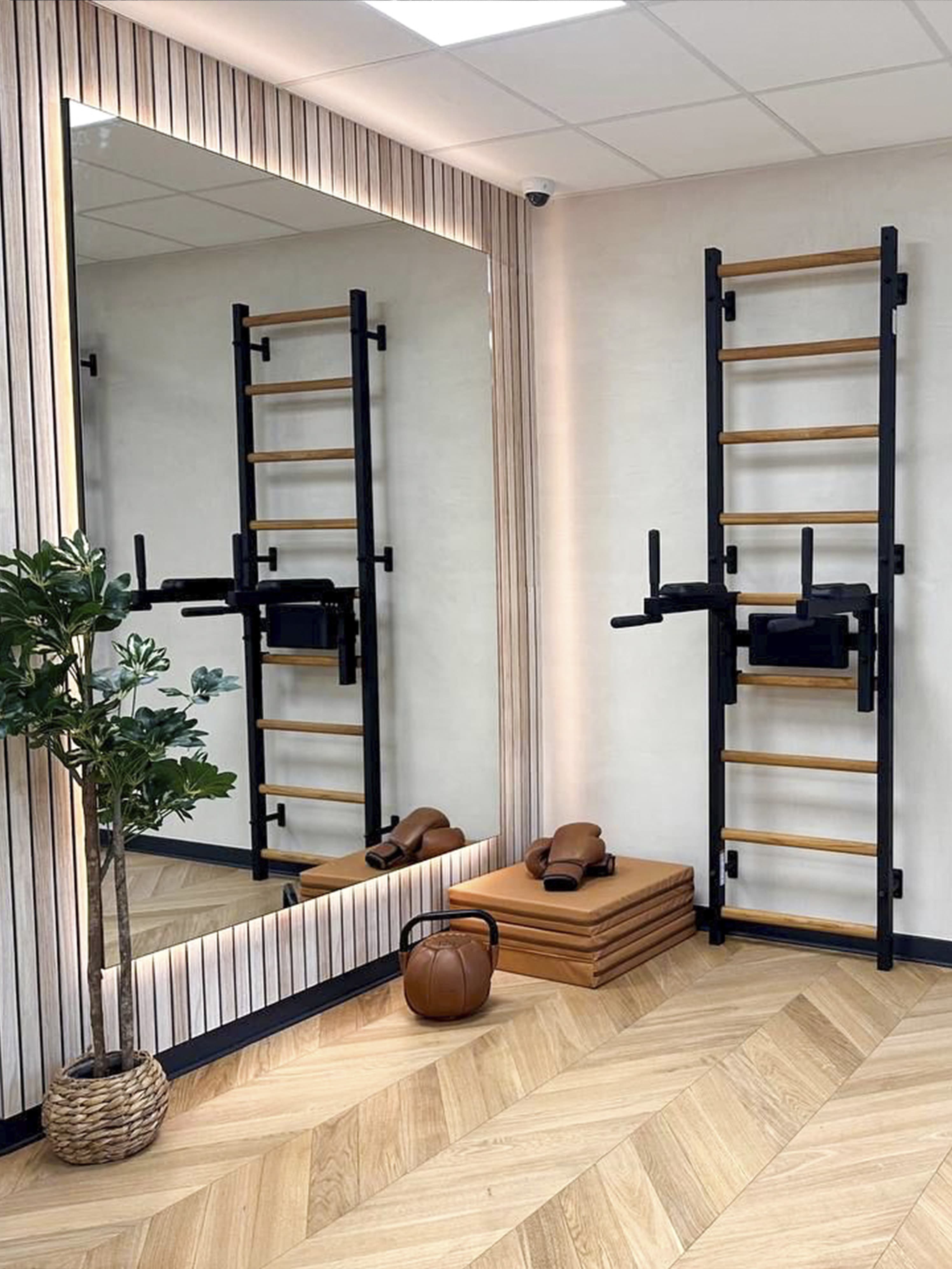
What is the yoga wall and why did B.K.S. Iyengar use it?
B.K.S. Iyengar developed his prop-based approach at his institute in Pune, India, starting in the 1960s. His core insight: props weren't crutches — they were tools that let practitioners experience correct alignment their bodies couldn't yet achieve on their own.
The yoga rope wall became a signature element of Iyengar studios worldwide. Ropes at specific heights let the practitioner hang, suspend, and support body segments during poses. The wall becomes an active participant — traction for the spine, support for inversions, resistance for strengthening.
What most American yoga practitioners don't know: the concept of using a wall-mounted ladder for body traction and supported movement is nearly 200 years older than Iyengar's rope wall. Wall bars — Sprossenwand in German — were developed in Sweden by Per Henrik Ling in the early 1800s for exactly this purpose: graduated anchor points for therapeutic movement.
Which yoga poses can you do on wall bars?
Twelve Iyengar-style poses enhanced or enabled by wall bars. Each uses the rungs as anchor points where you'd typically use ropes or wall hooks.
Supported inversions
1. Rope Sirsasana (Supported Headstand). Loop a yoga strap around a rung at hip height. Position your hips in the strap, walk feet back, lower head toward the floor as the strap supports your pelvis. Creates traction through the entire spine — same principle as the rope-wall version.
2. Viparita Karani (Legs Up the Wall, supported). Lie with back on the floor, hips near the bars. Walk feet up the rungs to your chosen height. Hook heels over a rung and let hips lift slightly. The rung gives more support than a flat wall — your heels actually grip something.
3. Adho Mukha Vrksasana (Supported Handstand). Face the wall bars, kick up, rest feet on a rung. The rung gives a specific anchor point. Move to higher rungs gradually as confidence builds.
Traction and spinal work
4. Wall Rope Uttanasana. Stand facing away from the bars. Grip a rung at waist height behind you. Fold forward while hands anchor you, creating gentle spinal traction as the upper body hangs.
5. Supported Urdhva Dhanurasana. Stand with your back to the bars, grip a rung at shoulder height. Arch backward slowly, walking hands down rung by rung. Each rung is a resting point — graduated approach is far safer than unsupported drop-backs.
6. Spinal Traction Hang. Grip a rung overhead, let body hang with feet on the floor (partial) or fully suspended. Axial decompression — same therapeutic traction PTs have prescribed using wall bars for decades. 30–90 seconds, 3–5 times.
Standing poses with support
7. Utthita Hasta Padangusthasana (supported). Face the bars. Place one foot on a rung at hip height (or higher for advanced). Hold a rung with the opposite hand for balance. The specific height creates a more stable version, letting you focus on hip opening instead of wobbling.
8. Ardha Chandrasana (Half Moon, wall support). Stand sideways to the bars with top hand resting on a rung. Stability to rotate chest open without fear of falling. Over time, lighten your grip — full hand, then fingertips.
9. Parsvottanasana. Face the bars, hands on a rung at hip height, one foot stepped back. Fold over your front leg while the rung supports your upper body.
Restorative and seated
10. Supta Baddha Konasana (supported reclined bound angle).Sit with back to the bars. Loop a strap around a low rung and your outer hips to keep knees supported. Recline over a bolster. Fixed anchor point that doesn't shift like a door anchor.
11. Seated spinal twist with bar assistance. Sit sideways to the bars. Use a rung at shoulder height as leverage — grip with both hands and rotate.
12. Supported Savasana variation. Lie face up. Rest calves on a rung at knee height so thighs hang vertically. 90° position relieves lower-back compression — particularly effective for practitioners with lumbar sensitivity.
Wall bars vs. a dedicated yoga rope wall
| Yoga rope wall | Wall bars (BenchK) | |
|---|---|---|
| Designed for yoga | Yes | No — multi-purpose training |
| Multiple anchor heights | 2–4 rope pairs at fixed heights | 8–9 rungs at graduated heights |
| Rope flexibility | Ropes swing and conform to body | Rigid rungs — fixed position |
| Traction work | Excellent | Good — fixed grip points |
| Inversions | Excellent with proper setup | Good — straps loop around rungs |
| Cost | $300–$600 hardware + installation | $635–$929 (includes pull-up bar option) |
| Additional training uses | None — yoga ropes only | Pull-ups, dips, hanging, strength, stretching |
| Adjustability | Fixed rope positions | Graduated rungs — exact height for your body |
| Floor space | Zero | Zero |
Honest answer: if you practice Iyengar exclusively and want the exact rope-wall experience, a dedicated rope wall handles pure rope work better. If you want yoga wall functionality PLUS a complete training station for strength, hanging, and mobility, wall bars deliver both in the same wall space.
What wall bar system works best for yoga?
Two models fit the yoga use case well:
BenchK 111 ($929) — Series 1, all solid beech with an adjustable pull-up bar. All-wood construction matches the natural aesthetic of most yoga spaces. No visible steel. FSC-certified beech, hand-oiled three times with food-safe oil — surface quality that matters when you press hands and feet against it daily.
BenchK 200B ($635) — Series 2 base, steel frame with beech rungs. More affordable. The steel frame is less visible from your practice position (you face the rungs, not the side rails).
Both mount to wall studs, take zero floor space. The 111 is 220 cm (87″) with 8 rungs. The 200B is 230 cm (91″) with 8 rungs.
For yoga specifically you'll also want two yoga straps (8' or 10') to loop around rungs for traction poses, a bolster for restorative work, and a non-slip mat. No additional BenchK accessories needed for yoga — the rungs are the tool.
Can wall bars help with yoga alignment?
Wall bars give two specific advantages:
Fixed reference points.Rungs are horizontal, evenly spaced, and don't move. Press shoulder blades against a rung — immediate feedback whether both sides are even. Touch specific rungs with back to the bars — instant feedback on thoracic extension. Fixed-surface feedback improves postural alignment accuracy (well-documented principle in rehabilitation science).
Graduated challenge.In Utthita Hasta Padangusthasana, the traditional approach is holding your big toe — which demands hamstring flexibility many practitioners don't have. A rung at the right height lets you place foot at your current level and work on hip opening and balance without compensating with a rounded spine.
Is this a replacement for yoga teacher training?
No. Wall bars are tools, not teachers. Every pose in this article should be learned from a qualified Iyengar teacher before you attempt it alone. Wall bars provide support and alignment feedback, but they don't correct form — that takes a trained eye. Especially true for inversions: supported headstands and handstands against wall bars are safer than unsupported versions, but they still demand proper technique.
Frequently asked questions
Can I replace my yoga rope wall with wall bars?
What height should wall bars be for yoga?
Do I need special attachments for yoga on wall bars?
How much wall space do wall bars need?
Are wooden wall bars better than steel for yoga?
Can I use wall bars for restorative yoga?
How do wall bars compare to a yoga wall unit like the Great Yoga Wall?
Will wall bars damage my wall?
See the system in full.
Configure your BenchK — wall bar, attachments, and accessories — and ship anywhere in the U.S.