
What Is the Kirsch Hanging Protocol — and Does It Actually Fix Shoulder Pain?
The Kirsch hanging protocol is a shoulder routine developed by Dr. John M. Kirsch, a board-certified orthopedic surgeon: hang from an overhead bar in 10–30 second intervals until you accumulate 10–15 minutes per day, plus light dumbbell raises. Most of what's written about it either oversells it or waves it away. We're going to do neither.
Who is Dr. John Kirsch?
John M. Kirsch, M.D., is a board-certified orthopedic surgeon (American Board of Orthopaedic Surgery). He earned his medical degree from the University of Illinois College of Medicine in 1964 and spent decades in practice in Stevens Point, Wisconsin, where he helped pioneer arthroscopic technique in the region. Later he founded the self-styled Kirsch Institute for Shoulder Research.
Before you weigh his claims, two things you should know.
The book is self-published.Shoulder Pain? The Solution & Prevention (first edition 2010, fifth revised edition 2019, 136 pages) came out through Bookstand Publishing, an author-pays imprint. That doesn’t make it wrong. It does mean no journal editor or peer reviewer ever vetted it.
He is not the “Kirsch JM” you’ll find on PubMed.That’s Jacob M. Kirsch, a Boston shoulder surgeon — a different person entirely. John Kirsch’s shoulder research has no PubMed-indexed publications.
So: a credentialed surgeon with a genuinely interesting idea, publishing outside the normal scientific channels. Hold both halves of that sentence at once. You’ll need them for the rest of this article.
What exactly does the Kirsch protocol involve?
Here is the protocol exactly as Kirsch lays it out in his book (numbers as summarized by clinicians at advanced-health.com.au). His prescription, not ours:
| Kirsch's prescription | |
|---|---|
| Hang duration | 10–30 second intervals, with rests between |
| Daily volume | Accumulate 10–15 minutes of total hanging per day |
| Frequency | Daily or near-daily during the initial phase |
| Starting intensity | Feet lightly touching the floor (partial body weight), progressing toward full hangs |
| Accessory work | Light dumbbell raises: 1–2 kg (about 2–4.5 lbs), 30–45 repetitions |
| Maintenance phase | Hanging 2–3 times per week once symptoms improve |
Look at the daily volume row again, because it’s not what most people assume. This is not “do a 30-second dead hang after your workout.” It’s a high-frequency, low-intensity daily practice — closer in spirit to physical therapy homework than to a gym exercise. That accumulated 10–15 minutes, every day, is the part almost every social media summary gets wrong.
One place where we deliberately depart from the book: our guidance throughout is that discomfort is okay, but pain is a stop signal. If a hang produces sharp or worsening pain, stop and get assessed. No protocol is worth pushing through pain for.
Why would hanging help a shoulder in the first place?
Kirsch’s argument starts with evolution. The human shoulder is an odd joint: it trades stability for an enormous overhead range of motion, a layout anatomists generally attribute to our tree-dwelling, arm-swinging ancestry — brachiation, if you want the technical term. Kirsch’s view, stated plainly, is that a joint built for hanging and climbing now spends modern life doing neither. That framing is background reasoning, not proof. But it does explain why the idea resonates: hanging asks the shoulder to do the one thing it’s most obviously shaped for.
His specific mechanism is more concrete, and more contested. Kirsch hypothesizes that the coracoacromial (CA) arch — the ligament-and-bone roof over your rotator cuff — stiffens over years of disuse, narrowing the space underneath. Hanging, he argues, presses the humeral head against that arch, gradually stretching the CA ligament and even remodeling the acromion. His evidence: CT scans he took in 2004 of subjects in a simulated hang, printed in his book. (His term for this contact point, the “acromiohumeral joint,” is his own coinage — you won’t find it in standard anatomy texts.)
Is any of that plausible? Partially. A 2024 ultrasound study in JOSPT Open found that inferior glenohumeral traction does increase the acromiohumeral distance — by 3.90 ± 0.51 mm when clinician-applied, 1.68 ± 0.49 mm when self-applied (JOSPT Open, 2024). So traction genuinely creates space in the shoulder, temporarily. Whether repeated temporary traction produces permanent remodeling, as Kirsch claims, has never been independently tested. Keep that temporary-versus-permanent distinction in mind; it’s where most retellings of the protocol quietly cheat.
For decompression-style shoulder work beyond hanging, see our guide to shoulder decompression exercises at home.
Does the evidence actually support the Kirsch protocol?
This is where an honest answer separates itself from a sales pitch. Claim by claim:
| What the evidence actually shows | |
|---|---|
| “90 of 92 patients returned to comfortable daily activity” | Kirsch's own case series (92 patients, 1980–2012, including 16 MRI-confirmed rotator cuff tears), published in his book — not in any journal. No control group, no randomization, and the author was both treating physician and outcome assessor. Interesting, not proof. |
| “Hanging remodels the acromion and stretches the CA ligament” | A hypothesis based on Kirsch's own 2004 CT scans of simulated hangs. No independent replication exists. |
| “Hanging decompresses the subacromial space” | Partially supported — traction transiently increases acromiohumeral distance by up to ~3.9 mm (JOSPT Open, 2024). Temporary distraction is real; permanent widening is unproven. |
| “Shoulders improve because the space gets wider” | Shaky. The CSAW trial (Beard et al., The Lancet, 2018), placebo-controlled across 32 UK hospitals, found surgery to widen the subacromial space gave no clinically important benefit over placebo surgery. Benefits may come instead from progressive loading, mobility, and tissue tolerance. |
| “Hanging is safe for everyone” | No. Physiotherapists Charlotte Ganderton (Swinburne) and Sarah Warby (La Trobe) caution in The Conversation (April 2023) that the shoulder is inherently unstable and hanging can stress it, particularly in people with hypermobility or instability. |
| “Dead hangs are good for you generally” | Well supported. Grip strength (a widely used health and longevity marker), shoulder mobility, and lat/thoracic stretching are the best-documented benefits of hanging (Healthline; GoodRx; TODAY). The “decompression feeling” is real as a sensation, even where the structural claims are weak. |
The fair summary: hanging is a legitimate, low-cost mobility and grip practice with mainstream endorsement. The Kirsch protocol as a treatment for impingement or cuff tears is an unproven — though not disproven — claim resting on one surgeon’s uncontrolled observations. Clinicians who reviewed his work put it bluntly: the study was never published, and nothing to date substantiates the treatment claims (APTEI physiotherapy education review, aptei.ca).
That doesn’t mean the 90-of-92 figure is fabricated. It means nobody has checked. There’s a difference, and this whole topic lives inside it.
Who should not try the hanging protocol?
Hanging loads the shoulder, elbow, wrist, and grip with up to your full body weight. Skip it — or get clinical clearance first — if any of these apply:
- Shoulder instability or hypermobility, a history of dislocation, or a labral injury
- A full-thickness or large rotator cuff tear (Kirsch’s series included MRI-confirmed tears — that’s his claim to test in a clinic, not yours to test in a garage)
- Acute, painful impingement — a currently angry shoulder is not the moment to start
- Recent upper-limb or neck injury, or post-surgical recovery
- Significant wrist or elbow problems that make gripping painful
And the standing rule: this article is not medical advice. If you have diagnosed shoulder pathology, talk to your doctor or physical therapist before hanging from anything.
How do you start hanging safely at home?
Below is a conservative six-week on-ramp. To be clear: this is our cautious adaptation, not Kirsch’s own program and not medical advice. It blends his feet-supported starting point with the safety guidance from Ganderton and Warby in The Conversation (2023): start with holds of 10 seconds or less, never hang to exhaustion, keep active tone in the shoulders rather than a dead slump, and step off a box instead of jumping or dropping.
| Load | Hold time | How | |
|---|---|---|---|
| Week 1 | Feet fully planted | ≤10 sec × 4–6 holds | Grip a bar or rung at about head height, feet flat, knees soft. Lean into a gentle stretch, shoulders lightly engaged. |
| Week 2 | Feet planted, deeper bend | ≤10 sec × 5–8 holds | Bend the knees more so your arms carry more weight. Stop well short of fatigue. |
| Week 3 | Partial weight | 10–15 sec × 5–6 holds | Grip higher so roughly half your weight hangs from your hands, feet lightly touching. |
| Week 4 | Mostly hanging | 10–20 sec × 5–6 holds | Only toes touching the floor or a low support. Worked grip and stretched shoulders — not pain. |
| Week 5 | First full hangs | ~10 sec × 3–5 holds | Step off a box into a full hang; step back onto it to finish. No jumping, no dropping. Keep active shoulder tone. |
| Week 6 | Full hangs | 10–30 sec intervals, 2–5 min accumulated | Short intervals with rests. Build total daily time gradually if your shoulders respond well. |
Progress by feel, not by calendar. A week here is a suggestion, not a deadline — some shoulders will want three weeks at stage two, and that’s fine. Mild stretch and forearm burn are normal; sharp, pinching, or radiating pain means stop. If your interest is hanging for general fitness rather than the Kirsch protocol specifically, our grip strength training guide covers hanging form, grip variations, and long-term progression.
What do you need to hang from?
Here’s the practical hurdle almost nobody mentions: the feet-supported starting phase needs grip points at multiple heights, and most home pull-up setups give you exactly one.
| Cost | Grip heights | Partial-weight progression | |
|---|---|---|---|
| Doorway pull-up bar | Inexpensive | One | Awkward — knee-bend only |
| Wall- or ceiling-mounted pull-up bar | Moderate, plus installation | One | Knee-bend only |
| Gymnastic rings | Inexpensive, plus an anchor point | Adjustable straps | Possible but unstable |
| Wall bars with rungs | $635–$1,069 | 8–9 rungs plus optional bar | Built in — this is what rungs are |
The honest read of that table: a doorway bar is the cheapest entry — verify the weight rating and your door frame, and know that its low clearance means bent knees for most adults, and daily 10–15 minute use is a lot to ask of a friction-mounted bar. A mounted bar is solid but still a single height. Rings swing — an unstable grip is exactly what a sore, deconditioned shoulder doesn’t need in week one.
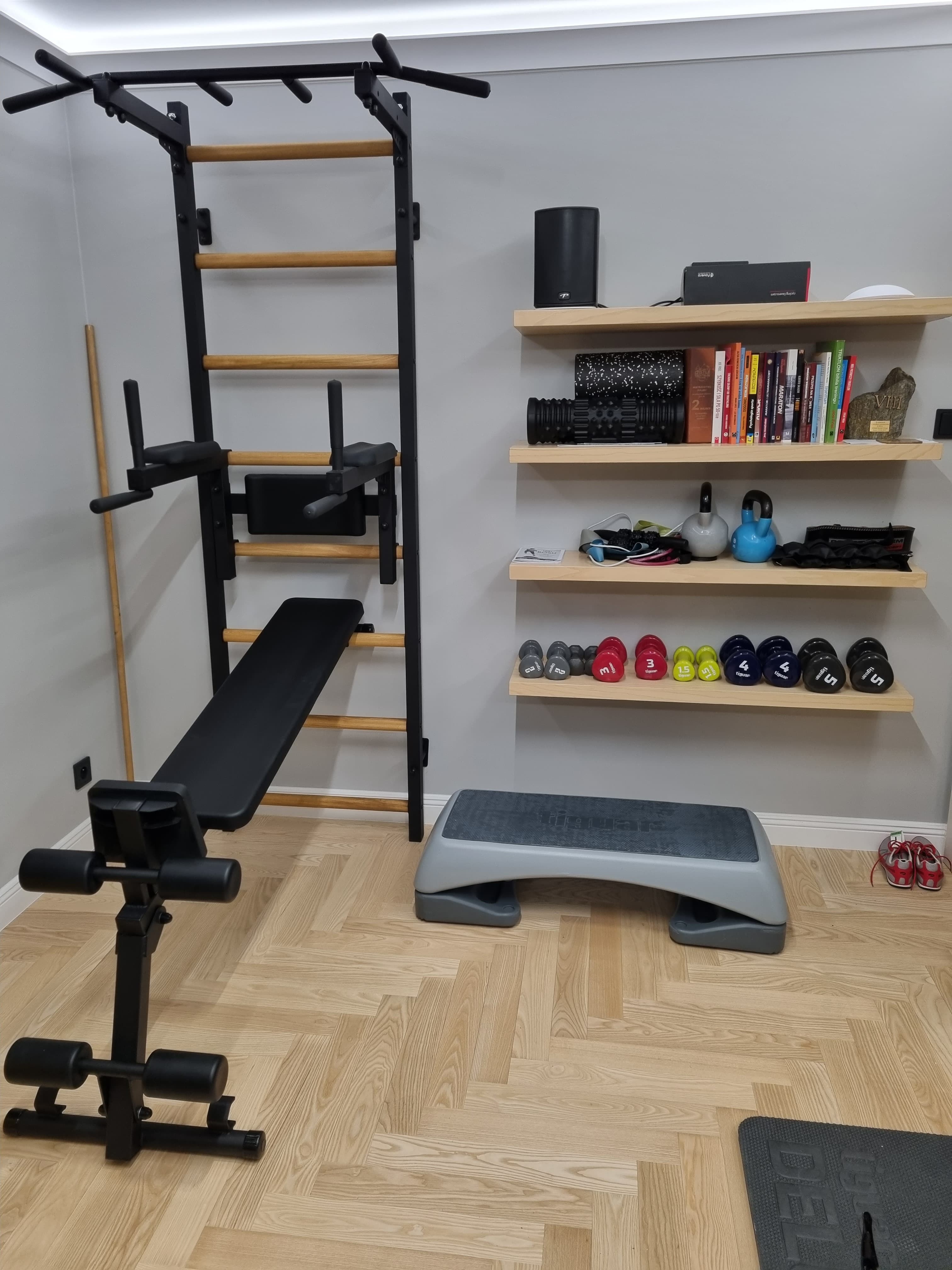
On wall bars, “feet lightly touching the floor” becomes “grip one rung higher each week.” BenchK Series 1 (solid beech) from $649, 120 kg / 265 lbs capacity; Series 2 from $635 and Series 7 from $689 (steel + beech), both 150 kg / 330 lbs. The BenchK 211B ($915) adds a height-adjustable pull-up bar; the 221B ($1,019) adds a fixed 6-grip steel bar for varying grip width during daily hangs; the 721B ($1,069) pairs that same 6-grip bar with the Series 7 frame.
We make wall bars, so weigh that table accordingly — but the structural point stands on its own: the protocol starts at partial body weight and progresses gradually, and rungs at every height from knee to overhead are the most direct way to run that progression. A doorway bar gives you the destination without the staircase. (Mind your ceiling: Series 2 needs 240 cm / 94.5 in minimum; Series 7, 250 cm / 98.5 in.)
One thing we will never claim: that any piece of equipment — ours included — treats or cures shoulder pain. Equipment gives you something to hang from; what happens next depends on your shoulders, your consistency, and ideally your physical therapist. To be equally clear: Dr. Kirsch has no association with BenchK and does not endorse our products. If rungs sound like the right tool for the job, the wall bar systems at benchk.us show every configuration with ceiling-height requirements listed.
This article is general information, not medical advice. If you have shoulder pain, instability, a diagnosed injury, or recent surgery, consult your doctor or physical therapist before starting any hanging program.
Frequently asked questions
How long should you hang per day on the Kirsch protocol?
Is the Kirsch hanging protocol scientifically proven?
Can hanging fix a rotator cuff tear?
What's the difference between the Kirsch protocol and regular dead hangs?
What if I can't support my body weight on a bar?
Is hanging safe if my shoulders are hypermobile?
How do I get down from a hang safely?
See the system in full.
Configure your BenchK — wall bar, attachments, and accessories — and ship anywhere in the U.S.