
Nala Moves Wall Bars Review (2026): Specs, Alternatives, and What to Check Before You Buy
Nala Moves wall bars are a legitimate product: Finnish birch, a manufacturer-claimed 330 lb capacity, clean Scandinavian looks, and prices starting around $450. Whether they're the right buy comes down to two questions most shoppers never ask: is the capacity claim backed by a published test standard, and can the unit grow after it's bolted to your wall?
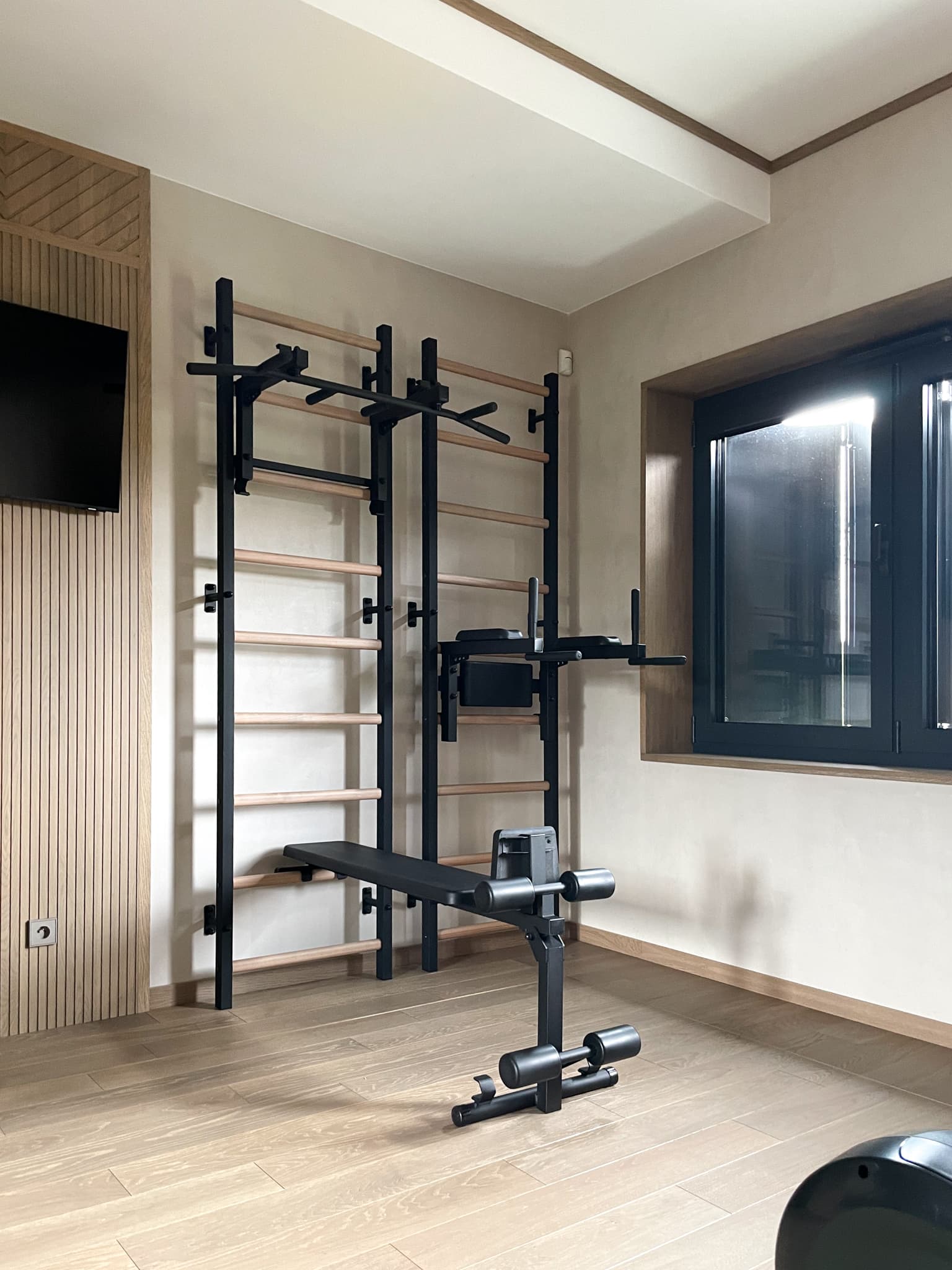
Up front: this is a published-specifications comparison, not a hands-on test. Every Nala Moves fact below comes from their own store, nalamoves.shop, verified August 2026; every BenchK fact from our 2026 catalog and benchk.us. Where something isn’t published, we say so.
What are the wall bars everyone is seeing on Instagram?
That wooden ladder bolted to a living room wall? Those are wall bars — stall bars in American gyms, a Swedish ladder on Amazon. A wall-mounted frame of horizontal wooden rungs, invented in Sweden in the early 1800s — so ordinary in European schools, physiotherapy clinics, and gyms that nobody there thinks to film them. Most Americans are meeting them for the first time through social media.
A lot of that first contact runs through one account: @nala.moves, roughly 539,000 followers as of August 2026, run by Nala Moves founder Natalia Bartholdi, a Finnish athlete and former competitive cheerleader. Her videos have introduced more Americans to this category than decades of clinical use in Europe ever managed. That deserves credit — category education is the hardest, most expensive work in any market, and she did it with a phone.
So the question isn’t whether wall bars are worth having. It’s which system deserves the wall — because you only drill it once.
What does Nala Moves actually sell?
Here’s the lineup as published on nalamoves.shop, verified August 2026. The store displayed prices in EUR to our US visits; dollar figures are approximate conversions at the August 2026 rate of about €1 = $1.15, not official US sticker prices.
- Nala Bars (wall bars only): from €389 (~$450).Finnish birch, made in Finland by their account. Heights 230 cm (90.5″) or 200 cm (79″), width 70 cm (27.5″). Manufacturer-claimed capacity: 150 kg / 330 lbs.
- Nala Bars Combo (bars + detachable Pull-up/Dip Extension): €570 sale / €638 regular (~$655–$735).
- Compact Bars Combo: €485 sale (~$560)— a 118 cm (46.5″) short unit for tight spaces.
- Pull-up/Dip Extension standalone: €249 (~$285), manufacturer-rated 120 kg / 265 lbs — lower than the bars themselves, per their own product page.
- Bundle (bars + extension + gymnastic mat + rings): from €759 sale (~$875).
Every product ships with the Nala Moves workout app — genuinely smart, since the founder built the app before the equipment, which solves the first-time buyer’s problem: it’s on the wall, now what? Their site claims free US shipping in 3–5 business days, assembly in under an hour, and mounting hardware in the box for concrete, brick, wood, stone, and wood-framed plasterboard. Their Trustpilot page held 28 reviews as of August 2026, predominantly positive — solid materials, easy assembly, responsive service. A small base, but nothing in it points to quality problems.
Two facts from their own pages will matter later. One: Nala Moves publishes a one-year warranty covering manufacturing defects for home use, per their refund policy page. Two: the site does not publish safety-standard certifications on its product pages — no EN 12346, no EN 913, no equivalent standard cited anywhere we could find, checked August 2026. The 330 lb figure is a manufacturer claim. Normal for direct-to-consumer brands — but a different kind of statement than a certified rating, and the difference gets its own section below.
What is your wall worth? (The question nobody asks before drilling)
Almost nobody runs this math before buying.
The median listing price for a US home was $228 per square foot in June 2026, according to Realtor.com data published by the Federal Reserve’s FRED database. Wall bars take up roughly 2.5 feet of wall width plus 6–7 square feet of clear floor in front for training — call it 15–20 square feet of usable home. At the national median, that’s $3,400–$4,500 worth of real estate you already paid for, before any equipment at all.
The wall bars aren’t the expensive part. The surface they occupy is.
That’s the strongest argument for wall bars — Nala’s included. A treadmill claims 15 square feet of floor and never gives it back. Wall bars use vertical space that was earning nothing, and the floor in front stays usable the other 23 hours a day. European physiotherapy clinics have kept stall bars on their walls for over a century for exactly this reason.
But the same math raises the stakes on what you mount. If the wall represents $3,000–$4,500 of your home, the gap between a roughly $655 fixed unit and a $969 expandable system isn’t really a $314 decision — it’s about what that patch of real estate does for the next twenty years.
Can it grow after it’s mounted?
The biggest structural difference between the two brands has nothing to do with wood quality. A fixed unit is a purchase. A modular system is infrastructure.
The Nala Moves ecosystem, per their full catalog as of August 2026, is the wall bars plus one attachable accessory — the Pull-up/Dip Extension (€249, rated 120 kg). Their other products (a standalone pull-up bar, gymnastic rings, a mat, a table) are sold as separate pieces, not as attachments to the bars. There is currently no bench, suspension trainer, punching bag holder, or kids’ gymnastics attachment in their catalog. What you buy on day one is, with one exception, what you’ll have in year five.
That isn’t a flaw — for stretching, mobility work, and hanging, a fixed unit does the job.
But here’s the switching cost nobody prices in: the wall is already drilled. Buy a fixed unit and outgrow it in year two — dips with back support, a bench for core work, rings for your kid — and there’s nothing to add. You’d have to take the unit down, patch, repaint, buy a different system, drill fresh holes. Almost nobody does. They stop progressing, or buy a second piece of standing equipment and surrender the floor space the wall bars were supposed to save.
A modular system flips the equation. BenchK wall bars are built as a chassis: the frame you mount on day one accepts a pull-up bar, dip bar, bench, suspension trainer, punching bag holder, and gymnastics set — all attaching to the original bars — no new holes. You’re not deciding today what your training looks like in 2031 — you’re keeping the option open, on the same drilled wall.
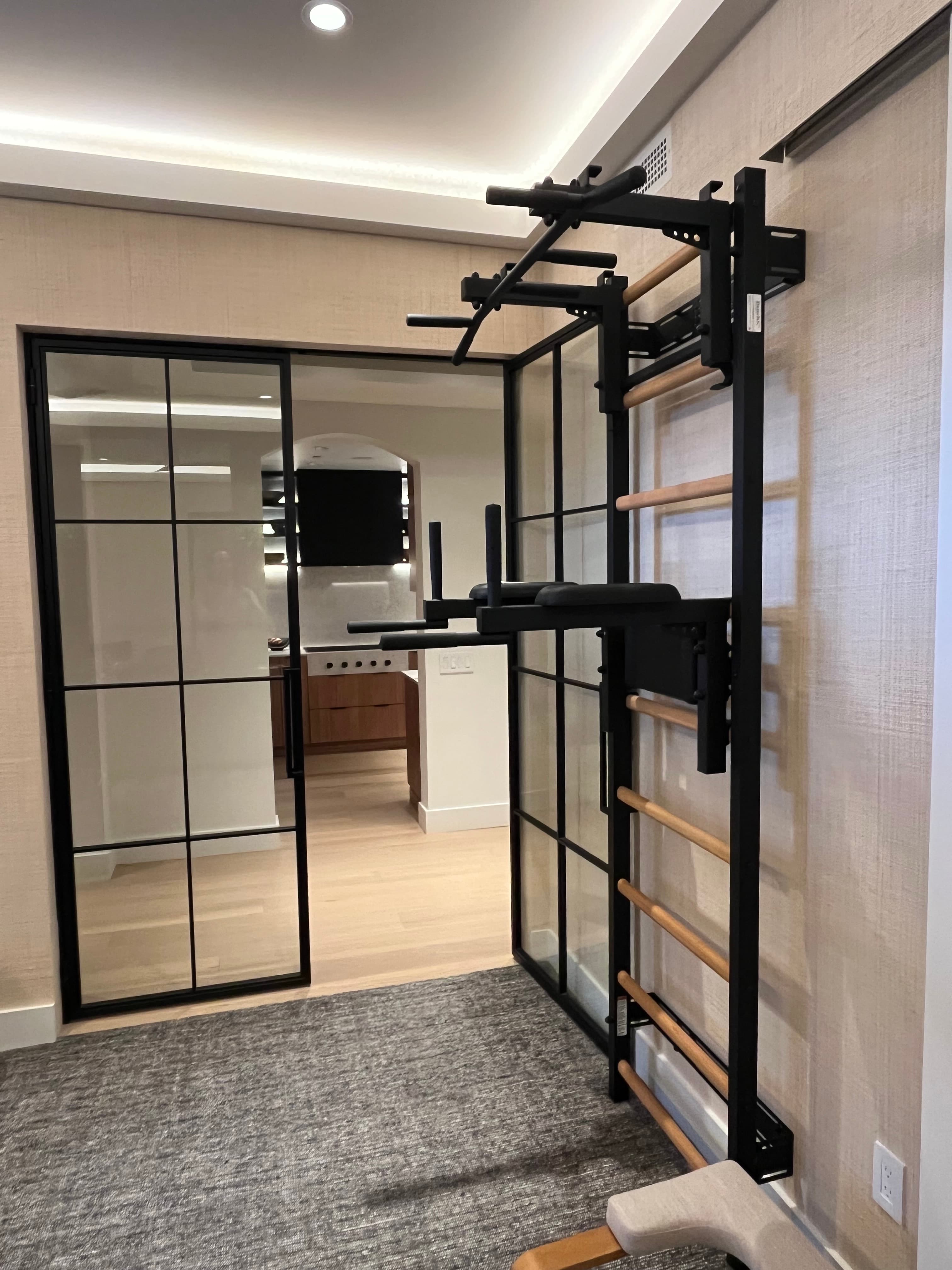
Whether that option is worth paying for is your call — but know it exists before the drill comes out, because afterward the decision is made.
How do Nala Moves and BenchK compare, spec by spec?
The table puts the Nala Bars Combo (their bars-plus-extension configuration) next to three BenchK configurations, from the BenchK 711B at $969 to the VMS at $2,955. Strictly speaking, that’s a cross-class comparison — a home fitness product next to commercial-grade systems. It’s worth making anyway, because the sticker prices sit close enough that real shoppers weigh these against each other every day.
| Nala Bars Combo | BenchK 711B | BenchK 722B | BenchK VMS | |
|---|---|---|---|---|
| Price | €570 sale / €638 regular (~$655–$735)¹ | $969 | $1,699 | $2,955 |
| What's included | Wall bars + detachable pull-up/dip extension | Wall bars (9 rungs) + adjustable beech pull-up bar | Wall bars + steel 6-grip pull-up bar + dip bar | 2 wall bars + multifunctional pull-up bar + dip bar + Recoil S2 suspension trainer |
| Construction | Finnish birch (all wood)¹ | Powder-coated steel frame + FSC beech rungs | Steel frame + FSC beech rungs | Steel frame + FSC beech rungs |
| Bars capacity | 150 kg / 330 lbs — manufacturer claim, no test standard cited¹ | 150 kg / 330 lbs, certified² | 150 kg / 330 lbs, certified² | 150 kg / 330 lbs, certified² |
| Attachment capacity | Extension rated 120 kg / 265 lbs¹ | Full configuration rated 150 kg / 330 lbs² | Full configuration rated 150 kg / 330 lbs² | Full station incl. Recoil S2 rated 150 kg / 330 lbs² |
| Safety certification | Not published on site¹ | PN-EN 12346:2001, PN-EN 913:2019² | Same² | Same² |
| Warranty | 1 year, home use, manufacturing defects¹ | 10 years metal / 2 years other² | Same² | Same² |
| Height | 230 cm (90.5″) or 200 cm (79″)¹ | 240 cm (94.5″) | 240 cm (94.5″) | 240 cm (94.5″) |
| Attachable accessory categories | 1 (pull-up/dip extension)¹ | 7 (pull-up bars, dip bar, bench, Recoil suspension, gymnastics set, punching bag holder, desk)² | Same² | Same² |
| US fulfillment | Free US shipping, 3–5 business days claimed; shipping origin not published¹ | US warehouse (Largo, FL), free continental US shipping via UPS² | Same² | Same² |
| Commercial installations | Not published on site¹ | Harry's Home Hotels Austria (70 rooms), Praxis Pilates NYC, 10Ten Fitness Sarasota FL, PT clinics in California, France, Poland² | Same² | Same² |
| Workout app | Included¹ | No | No | No |
| Made in | Finland¹ | Poland and USA (Recoil: China)² | Same² | Same² |
¹ nalamoves.shop product and policy pages, verified August 2026; USD approximate at August 2026 exchange rates (€1 ≈ $1.15). ² BenchK 2026 catalog / benchk.us.
Read it honestly and Nala Moves wins three rows: entry price, the included app, and all-wood construction if that matters aesthetically (though BenchK’s Series 1 is all beech too — more on that below). BenchK wins on certification, warranty, ecosystem, US warehousing, and commercial track record. Which rows weigh most is your call. Our argument is narrower: first-time buyers systematically undervalue certification and expandability, because nobody on Instagram talks about them.
What does “certified” actually mean — and should you care?
Anyone can print “holds 330 lbs” on a product page. No inspector checks it. To be clear, we have no evidence Nala Moves’ figure is inaccurate — their build may well support every pound of it. But you, the buyer, have no way to know. A number without a named test standard is a promise, not a proof.
A certification is a different animal. BenchK wall bars are certified under PN-EN 12346:2001 and PN-EN 913:2019, the European standards for wall bars and gymnastic equipment (see our certifications). In plain English: an independent body tested the equipment against defined load, stability, and construction requirements — the kind written for schools and clinics, where failure means liability. “We say it holds you” versus “a third party verified it, to a standard you can look up.”
Does a home user stretching 20 minutes a day need certified equipment? Honestly — maybe not. Birch is a strong hardwood, and we found no reported failures of Nala bars. But two groups should care a lot. First, anyone doing loaded work: weighted pull-ups, dips, a 200 lb adult swinging on rungs all operate closer to any structure’s limits — and per their own product page, Nala’s pull-up/dip extension is rated 120 kg (265 lbs), below the 150 kg of the bars it hangs on. Second, any business: a Pilates studio, PT clinic, chiropractor, or hotel effectively can’t buy uncertified equipment, because insurer and lawyer ask the same question — “tested to what standard?” There’s a reason the equipment in Harry’s Home Hotels’ 70 rooms and at Praxis Pilates in New York carries EN certification. Equipment that survives daily commercial use will be bored in your living room.
This is the cleanest way to frame the whole comparison. BenchK is commercial equipment first — the same certified systems bolted into hotel rooms, PT clinics, and Pilates studios — that happens to be priced within reach of a living room. Nala Moves is sold and warranted for home use, per their own positioning and refund policy. Neither is the wrong thing to be. But when the prices land this close together, you’re not choosing between two versions of the same product — you’re choosing which class of product goes on your wall.
If the sticker gap still stings: the roughly $314 between Nala’s Combo at sale price and the certified 711B, spread across BenchK’s 10-year metal warranty, is under $3 a month. That’s what verification costs.
What can you add later? The ecosystem, priced step by step
The chassis idea in practice — one BenchK wall unit, mounted once, growing over years (all prices from the 2026 catalog):
- Day one — the bars. BenchK 700B, $689 (Series 7, 9 rungs, steel + beech). Or start at $969 with the 711B, which includes the adjustable wooden pull-up bar.
- Add a pull-up bar. Wooden adjustable PB076, $279; fixed steel 6-grip PB2, $379; or the convertible PB3, $549, doubling as a barbell holder.
- Add a dip bar. DB1B, $629 — back support and polyurethane armrests.
- Add a bench. B1B, $865 — rotatable, leg rollers, PU surface.
- Add suspension training. Recoil S2, $399–$459 depending on mounting kit — BenchK’s patented push-button suspension trainer. Clips to the rungs at any height, and works standalone on a door or ceiling.
- Add boxing. BBHB punching bag holder, $379, plus the BenchK bag, $450.
- Add the kids. The A076 gymnastics set — rope, wooden swing, adjustable rings — ships bundled with the bars: 211B + A076 runs $1,139, $224 over the bars alone. The bars you hang from become their climbing frame.
The system’s ceiling is the BenchK VMS at $2,955: two wall bar columns, multifunctional pull-up bar, dip bar, and Recoil S2 in one station. Nobody starts there. The point: the $689 entry and the $2,955 flagship share the same wall, the same holes, the same day-one decision — buy the chassis once, grow at whatever pace your training and budget do.
For how BenchK stacks up against the other premium brands Americans cross-shop — Rogue and NOHrD — see our BenchK vs Rogue vs NOHrD comparison.
Which wall bars should you buy? An honest segmentation
Each buyer decides for themselves. Here’s our honest read of who fits where.
Nala Moves fits you if:you want the lowest-cost entry into good-looking wooden wall bars (~$655 for the Combo at sale price, versus $915 and up for a comparable BenchK setup); the included app matters — a real beginner advantage BenchK doesn’t offer; your training is bodyweight mobility and stretching without heavy loading; and a one-year warranty horizon doesn’t bother you.
BenchK fits you if:what you actually want is commercial-grade equipment at close to a home-product price — a certified 330 lb rating rather than a claimed one; you expect your training to evolve — dips, bench work, suspension training, kids — and want the wall drilled exactly once; you’re a business, where certification and the 10-year metal warranty become requirements; or you want US-warehoused fulfillment and an 11-year track record (building wall bars since 2015).
Within BenchK, pick by material and ceiling. If the warm all-wood look drew you in, Series 1is our own answer to it — solid FSC beech, hand-oiled three times with food-safe oil, no steel in sight, $649 — less than Nala’s Combo at current exchange rates — rated 120 kg (265 lbs) and covered by the same two European safety standards as every BenchK wall bar. In a living room it reads as furniture, not gym equipment — which matters when you share that wall with someone who’d veto a power rack. Series 2 ($635 base) and Series 7($689 base) add the steel frame and the certified 150 kg (330 lb) rating. Wood isn’t the compromise; fixed-and-done is.
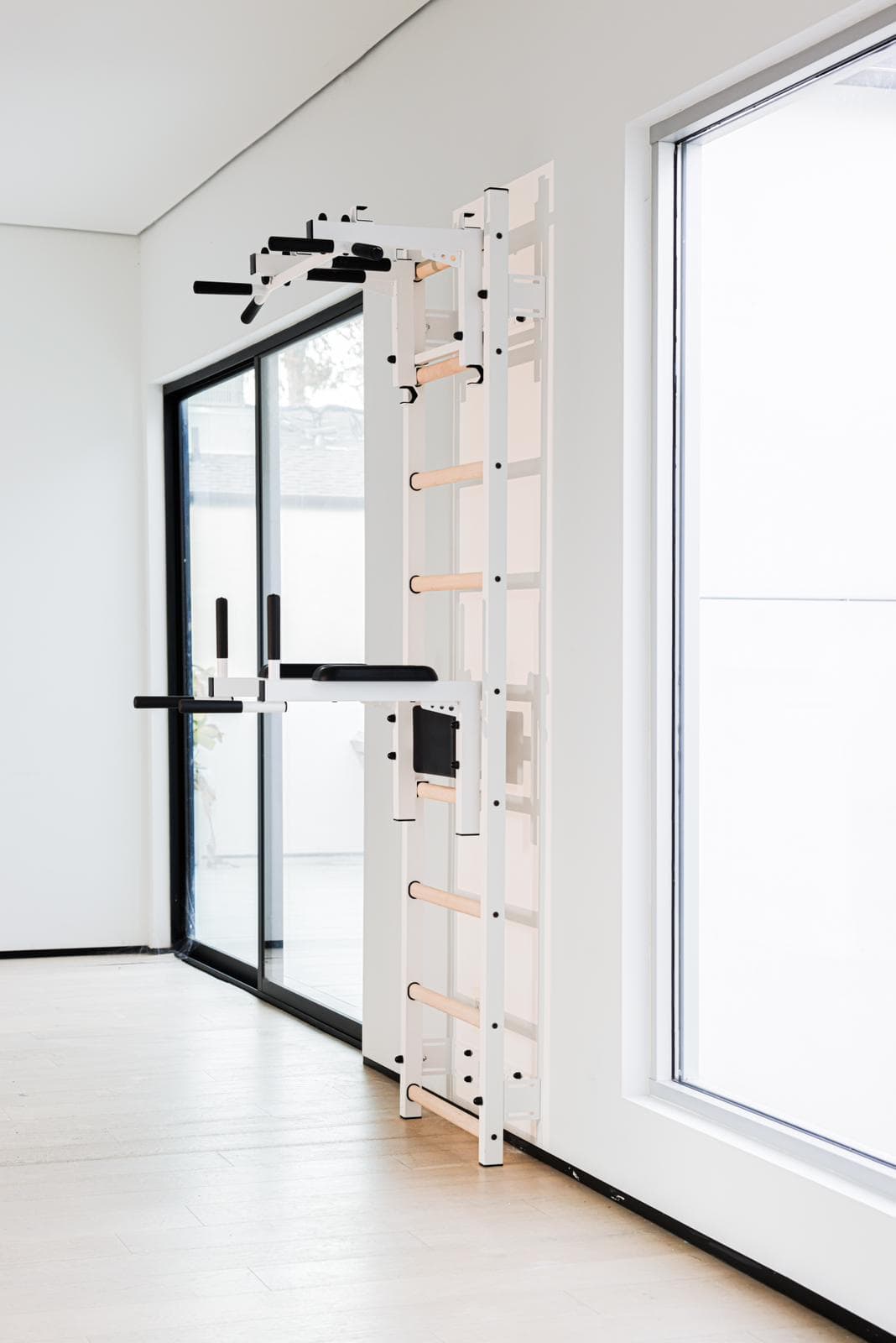
And measure your ceiling before you fall in love. Series 7 needs 98.5 inches — more than a standard 8-foot US ceiling — so most American homes should look at Series 2 (94.5″ minimum) or Series 1, which fits under 8-foot ceilings. Nala’s 230 cm bars want a 240 cm (94.5″) ceiling per their sizing guidance, with a 200 cm version for lower rooms.
Will wall bars damage your wall?
The fear that stops most first-time buyers: “I’m about to drill into my wall and hang a human from it.”
The rule, whatever brand you buy: never mount wall bars to drywall alone. Drywall anchors hold pictures, not people. The load has to reach structure — masonry, or the wooden studs behind the drywall. BenchK specifies hardware by wall type: PS8 or PS12 Fischer expansion plugs ($89–$99) for solid brick and concrete, and dedicated wall holders (WH1+S4 at $259, WHB+S8 at $289) that bridge across studs on American wood-frame walls.
Done right, the “damage” is a set of clean bolt holes that patch and paint over in an afternoon if you ever move. Done wrong — bare drywall, or one stud with short screws — no brand’s capacity rating means anything. A $30 stud finder settles it in ten minutes.
For what you can do once it’s mounted — including the decompression hangs that bring most back-pain readers here — see our guides to decompression exercises at home and wall Pilates equipment.
Where BenchK falls short
A comparison you can trust cuts both ways, so here’s ours.
- BenchK costs more upfront. The cheapest comparable configuration (211Bwith pull-up bar, $915) runs roughly $260 more than Nala’s Combo at sale price. That difference buys certification and warranty length — real things, but things some home users will reasonably decline to pay for.
- Series 7 won’t fit standard US ceilings. It needs 98.5 inches; an 8-foot ceiling is 96. Buy Series 2 or Series 1 instead.
- There’s no BenchK app. Nala Moves ships workout programming with every product; BenchK gives you exercise guides. Beginners who need daily structure will feel that gap.
- The Recoil is made in China. Wall bars and steel components are produced in Poland and the USA; the Recoil suspension trainer is manufactured in PRC.
- Mounting isn’t free or trivial. On US wood-frame walls, the correct wall holders add $259–$289, and installation is a two-person job.
Prices verified August 2026 (BenchK: 2026 catalog and benchk.us; Nala Moves: nalamoves.shop, EUR pricing, USD approximate at the August 2026 rate of about €1 = $1.15). This is a published-specifications comparison; we have not physically tested Nala Moves products. Full specs and configurations for every system in this comparison are on nalamoves.shop and benchk.us. Each buyer decides for themselves — our aim is that you decide with the full spec sheet in front of you.
Frequently asked questions
Are Nala Moves wall bars worth it?
What is a good alternative to Nala Moves wall bars?
Are wall bars, stall bars, and Swedish ladders the same thing?
Are cheap wall bars safe for adults?
Can you add a pull-up bar or dip bar to wall bars later?
Can wall bars be mounted on drywall?
What ceiling height do you need for wall bars?
Do wall bars work for wall Pilates?
See the system in full.
Configure your BenchK — wall bar, attachments, and accessories — and ship anywhere in the U.S.